
Scale with data precision
What ad tech CIOs need in a tactical playbook to clean up data and prove ROI faster

Key execution findings
Programmatic performance lives or dies on identity, attribution, and latency. Disconnected graphs, late consent checks, and spreadsheet joins slow every auction and confuse reporting. You do not need a rip and replace. This tactical playbook sequences fixes that raise attribution accuracy, cut bid latency, and prove lift to finance. Each phase lands while campaigns run, so you unlock win rate, reduce waste, and show ROI in weeks.
$168B
US programmatic spend in 2024, up ~$41B since 2022.*
100 ms
sub-100 ms round-trip is a common threshold for premium video auctions.*
60%
of firms risk missing AI value without cohesive governance.*
$309.3B
US digital ad spend projected in 2024, magnifying gains from latency cuts.*
SEP. 30, 2025
3 Min Read
This playbook offers a phased, outcome-first path. Start with identity integrity, then remove consent latency, normalize attribution, and tune end-to-end bid speed. Each phase ties to KPIs like attribution accuracy, spend reallocation speed, and round-trip latency. The result is a governed, real-time data foundation that improves win rate, clarifies ROI, and keeps compliance satisfied.
Why modernization matters now
Identity decay, consent delays, and mismatched attribution windows erode ad tech performance. With US marketers funneling massive budgets into programmatic, every millisecond of latency and every duplicate profile turns into lost revenue at scale. Teams burn hours on spreadsheet joins while platforms report conflicting conversions. Finance gets skeptical and product roadmaps stall.
How to execute without disruption
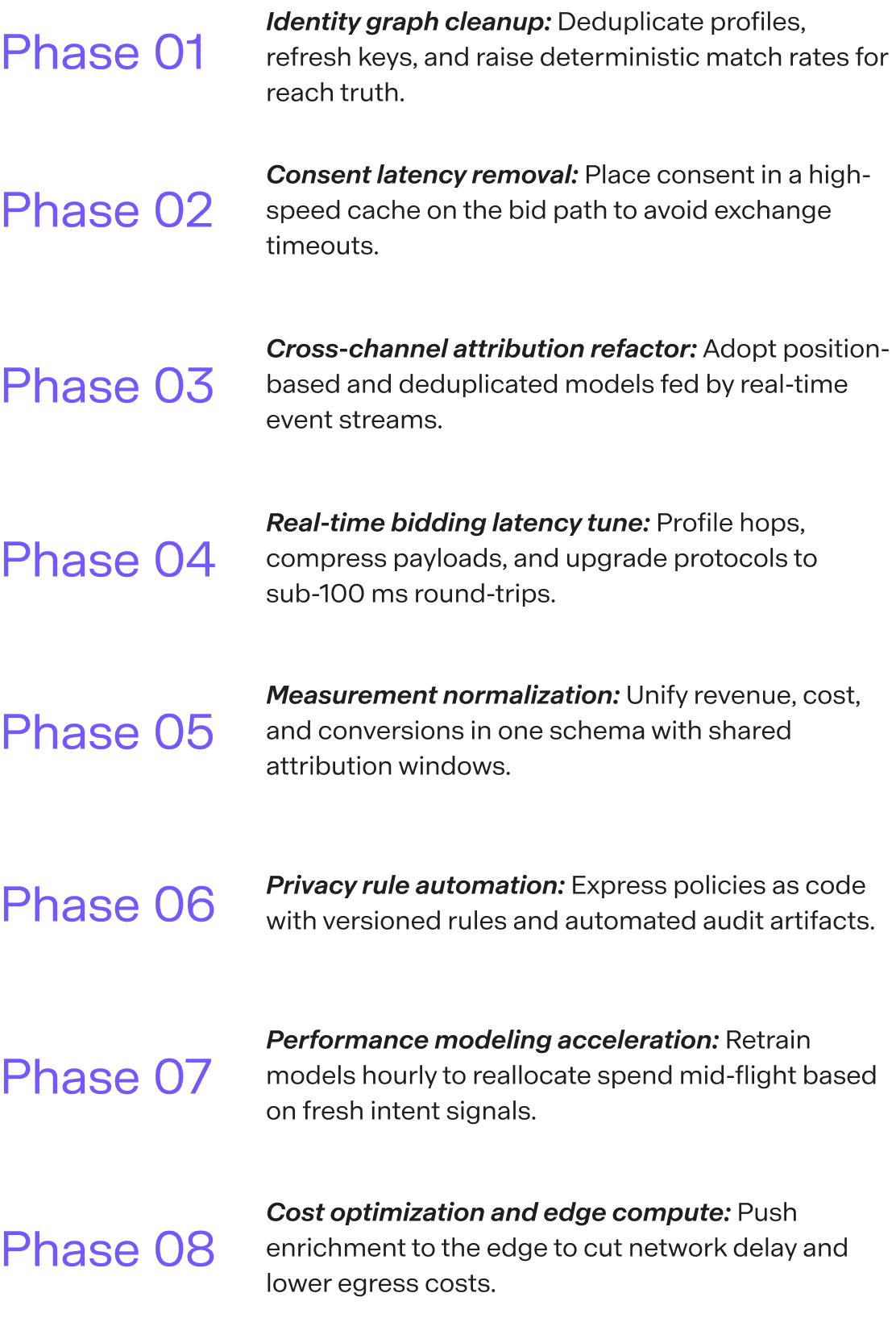
This playbook sequences eight phases that land value fast while campaigns keep running. Start by cleaning the identity graph so reach, frequency, and deduplication are credible. Move consent checks into an in-path cache to eliminate bid rejections. Shift attribution to real-time, deduplicated models so spend reallocation happens in minutes, not weeks. Then tune network and protocol latency to qualify for premium auctions. Normalize measurement in one schema, encode privacy as policy-as-code, accelerate predictive models, and finally move selective enrichment to the edge for speed and cost control. Each phase declares a KPI, owner, and target.
What results to expect
Expect lower duplicate reach, fewer consent-related bid rejects, and faster round-trip times. Attribution precision rises, exposing wasted spend you can reallocate immediately. Win rate improves on high-value inventory without extra budget, and dashboards converge to a single source of truth. Governance strengthens because privacy and schemas are enforced by code, not meetings. The outcome is a faster, cleaner, more accountable ad tech stack that proves ROI quarter after quarter.
*based on external research sources cited within.
Access the playbook CIOs use to modernize ad tech data
Need an executive summary? View our roadmap for data modernization in ad tech.
FAQs
How do I modernize ad tech data without rebuilding everything from scratch?
What are the key data metrics I should track to show impact in ad tech?
How can I improve consent handling without slowing my bidding systems?
What’s the fastest way to reduce reporting delays in ad tech operations?
Where should I start with governance in a fragmented ad tech stack?






Take the brighter path to software development.