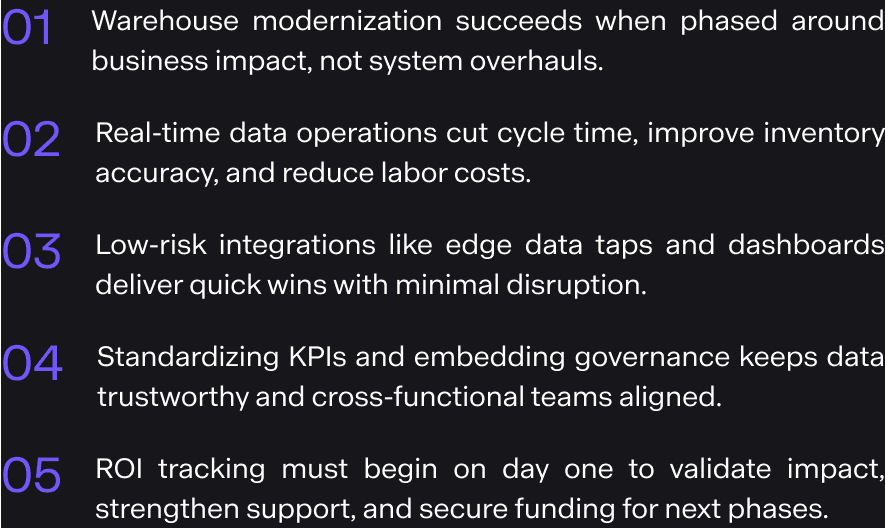
Key takeaways
Pinpoint where data delays, system silos, and manual steps are slowing fulfillment
CIOs tell us the bottleneck usually becomes obvious at shift change, when picks surge but system updates crawl. Multiple WMS instances, paper-based exceptions, and disconnected control systems force staff to reconcile records long after the forklift has moved the pallet. The average mis‑pick already costs about $30 to correct, yet most warehouses accept error rates
between 1% and 3%, compounding waste.
Identifying precisely where latency starts—and which manual step repeats it—creates the first lever for measurable improvement.
Typical delay nodes surface at handheld scanner uploads, batch interface schedules between WMS and ERP, and manual reconciliation of cycle counts. Edge controllers may store data locally for hours before exporting, starving planning dashboards of real-time location signals. Operators respond by over‑allocating safety stock, driving labor to cross‑check orders, and paying premium freight to recover from misaligned inventory.
Pinpointing delays provides executives with a concrete starting point instead of a vague modernization mandate. Quantifying minutes lost and dollars wasted turns technology discussion into a margin impact. Teams also gain a shared fact base for change, reducing friction between IT and operations. With diagnostic clarity in hand, leaders can tie fixes directly to financial and service targets addressed next.
Tie modernization efforts to margin improvement, delivery speed, and SLA performance
Warehouses live or die on cents per pick, not abstract platform metrics. Linking modernization work to EBITDA drivers shifts the conversation from servers to service-level agreements. A 2024 Gartner study shows
65% of firms that prioritize real‑time analytics outperform peers on revenue growth.
Faster data, therefore, widens the margin and accelerates cash conversion, giving CFOs tangible numbers to back new investments.
When inventory accuracy climbs from 97% to 99.5%, safety stock drops and carrying costs fall without risking stock‑outs. Cycle‑time cuts flow directly to on‑time‑in‑full (OTIF) improvement, often included in customer penalties and bonus schemes. Real‑time labor dashboards trim overtime by rebalancing tasks before lines back up, turning data latency into minutes of payroll saved each shift.
Framing modernization through these margin levers unites finance, operations, and IT behind the same scoreboard. Every API build or sensor rollout appears as a line on the income statement, not a line in the backlog. That makes modernization spending easier to rank against other capital projects. The approach also sets expectations for rapid payback, building urgency for sequencing wins.
Sequence changes to prioritize early wins, reduce risk, and prove value fast
A five‑year master plan rarely survives the first budget cycle. Breaking modernization into phased releases safeguards throughput while moving the KPI needle early. Interestingly, labor can account for
up to 65% of warehouse operating expenses, so the first phase should target workforce visibility where payback arrives quickest.
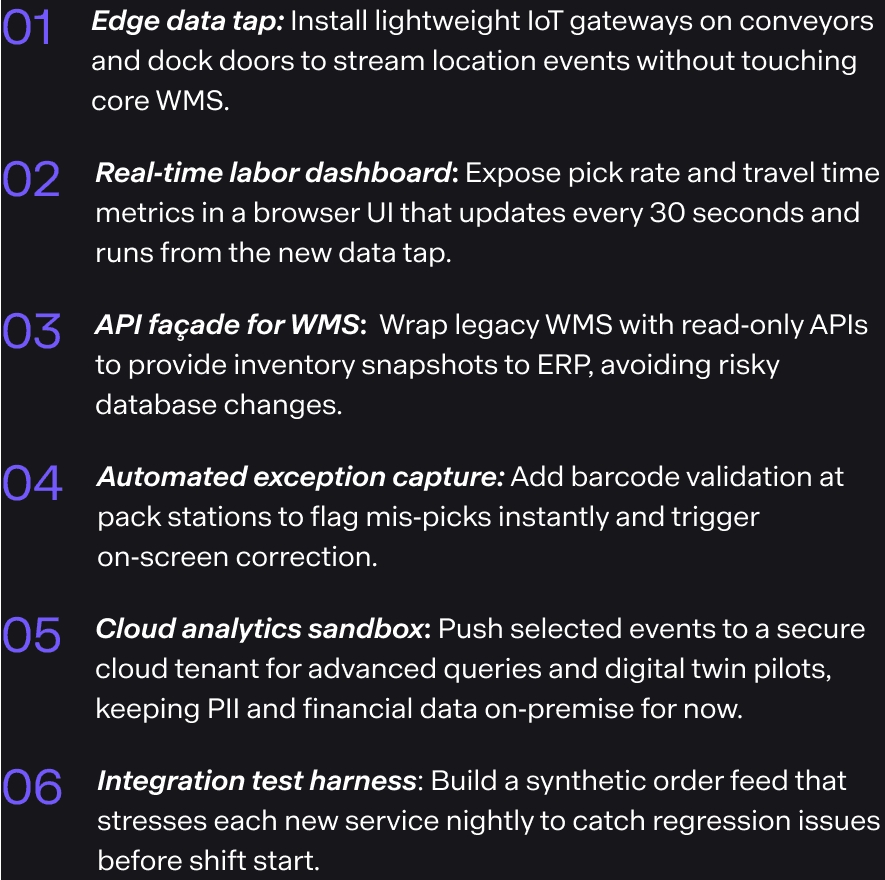
Risk stays low because core transactional logic remains untouched until a proven business case demands deeper change. The cadence also builds stakeholder confidence by tying every technical milestone to an operational outcome. This disciplined sequence prepares the foundation for a consolidated data layer covered next.
Build a warehouse data foundation that supports real‑time visibility and automation
High‑frequency sensor feeds are futile without a data platform built for sub‑second ingest and retrieval. Cloud logistics software is forecast to expand at a
10.2% compound annual growth rate through 2026, reflecting industry appetite for scalable infrastructure. Yet many warehouses still rely on overnight batch exports and fragile point‑to‑point interfaces. An event‑driven, cloud‑ready layer changes that equation.
Using a streaming backbone such as Apache Kafka or Azure Event Hubs allows scanners, PLCs, and yard management systems to push events once and let authorized consumers subscribe in near real time. A schema registry keeps payload versions consistent, so dashboards and machine‑learning models stay stable even as new devices come online. Downstream services then store curated facts in a managed data warehouse for historical analytics, giving planners both speed and depth from a single source.
With this foundation, future robotics or autonomous vehicle pilots plug into existing topics rather than forcing fresh integrations. Operators gain a live map of inventory while data scientists see a clean history for optimization work. Executives also acquire an architecture resilient enough to absorb mergers or new business lines. That structural integrity sets the stage for proactive governance.
Need a tactical view? Access our tactical playbook for data modernization in warehouse management.
Add governance that supports quality, access control, and real‑time correction
Governance often sounds like bureaucracy until a mismatched unit of measure halts shipping. Modern warehouses process thousands of events each second, so quality rules must sit in the stream, not a spreadsheet. Clear ownership, automated validation, and role‑based access prevent those errors from resurfacing at scale. The checklist below focuses on real‑time safeguards rather than after‑the‑fact audits.
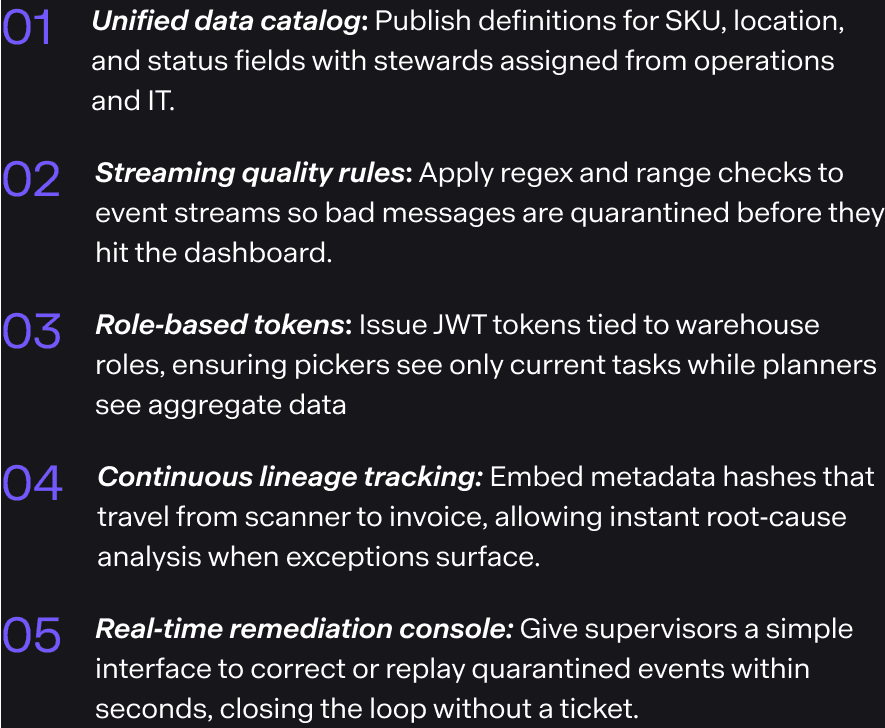
These practices keep performance data both trusted and secure as volume grows. Supervisors no longer wait for end‑of‑day reports to spot mislabeled pallets. Audit trails satisfy compliance requirements without slowing fulfillment. With governance in place, leaders can finally align everyone on the right metrics.
Standardize KPIs to align warehouse, fulfillment, and operations teams
No data initiative survives when teams calculate cycle time differently. A shared metric hierarchy turns pick, pack, and ship events into a common language. Only half of product‑centric enterprises invest in real‑time transportation visibility platforms, according to
Gartner, highlighting a wider KPI consistency gap across the chain. Establishing uniform definitions removes debate and concentrates energy on improvements.
Cycle time should span receipt to carrier handoff, measured in minutes and linked to SLA penalties. Inventory accuracy must reference both system quantity and location precision, reported as a rolling weekly average. Throughput belongs at the hourly level, benchmarked against labor hours to reveal hidden idle time.
Once KPIs match across functions, dashboards finally drive the same behavior in every department. Leaders gain an immediate view of trade‑offs between speed and cost. Continuous improvement teams can test process changes and see the impact within a single shift. Aligned metrics also simplify the ROI conversation that follows.
Track ROI at every step to strengthen buy‑in and unlock next‑phase funding
Modernization loses momentum when wins fade into quarterly noise. Linking each technical task to a financial metric avoids that fate. Executives need a running ledger that compares promised savings with actual cash impact. The framework below keeps that ledger living and visible.
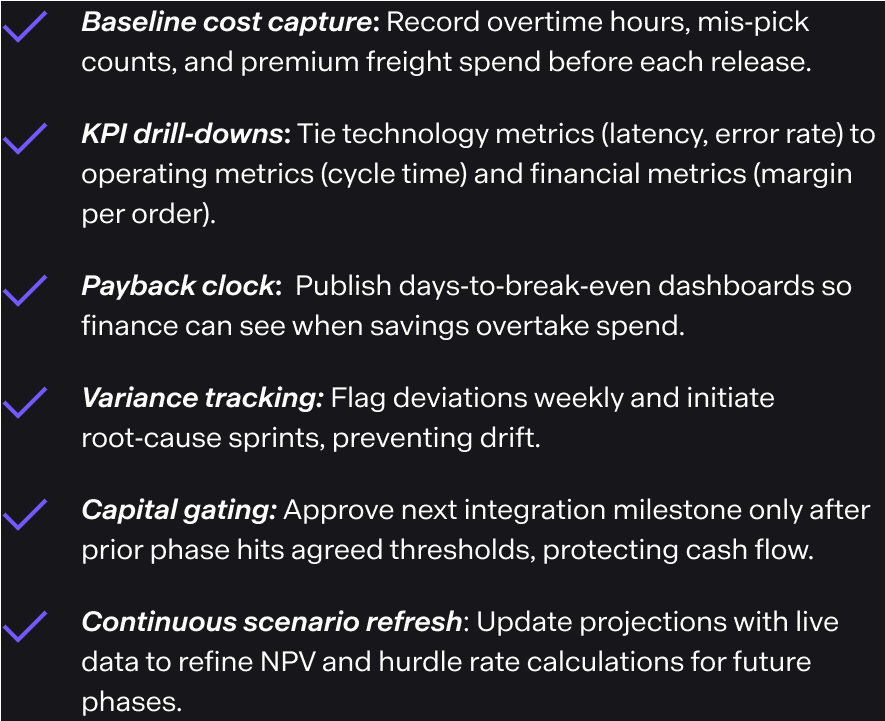
This loop turns modernization into a self‑funding program instead of a one‑time capital expense. Finance leaders appreciate transparent metrics tied to real behavior, not theoretical models. Operational staff see how their process changes show up on the income statement. The shared visibility keeps enthusiasm high just as deeper system work begins.
How Lumenalta®helps warehouse and logistics leaders modernize without disruption
Building on disciplined ROI tracking, our specialists steer each data sprint so shipping never pauses. We begin with a diagnostic that maps latency hotspots to dollar figures, giving leaders a facts‑based launch pad. Next, lightweight event streaming pilots deliver live dashboards within weeks, providing the quick wins essential for executive momentum. This phased support mirrors the sequence outlined above, ensuring every technical move anchors to the margin and SLA impact.
Lumenalta® brings pre‑built integration accelerators, a governance reference model, and an outcomes ledger that links code commits to cash flow. CIOs receive weekly ship‑ready increments, while operations teams gain real‑time insight into pick accuracy and cycle time. The partnership keeps risk low by insulating legacy systems until clear ROI thresholds justify deeper replacement. That pragmatic rhythm delivers modernization gains from day one, turning data into the most reliable worker on the floor.