
Scale with data precision
A tactical playbook for operationalizing data modernization in warehouse management

Key execution findings
Every shift lives or dies by data accuracy. Yet nearly half of warehouses still run on paper-based workflows that hide delays until it’s too late. Batch reports, legacy scanners, and disconnected spreadsheets bury operators in rework and keep CIOs guessing. This tactical playbook shows how to modernize warehouse data in phases—linking each step to measurable KPIs like throughput, labor efficiency, and fulfillment accuracy. You’ll raise productivity and lower cost without pausing daily operations.
44%
of warehouses still rely on paper-based picking, limiting visibility.*
30%
labor productivity gains recorded from standardized warehouse automation.*
62%
of organizations list supply chain resilience as their top investment priority.*
50%
of product-centric enterprises already investing in real-time data visibility.*
AUG. 21, 2025
3 Min Read
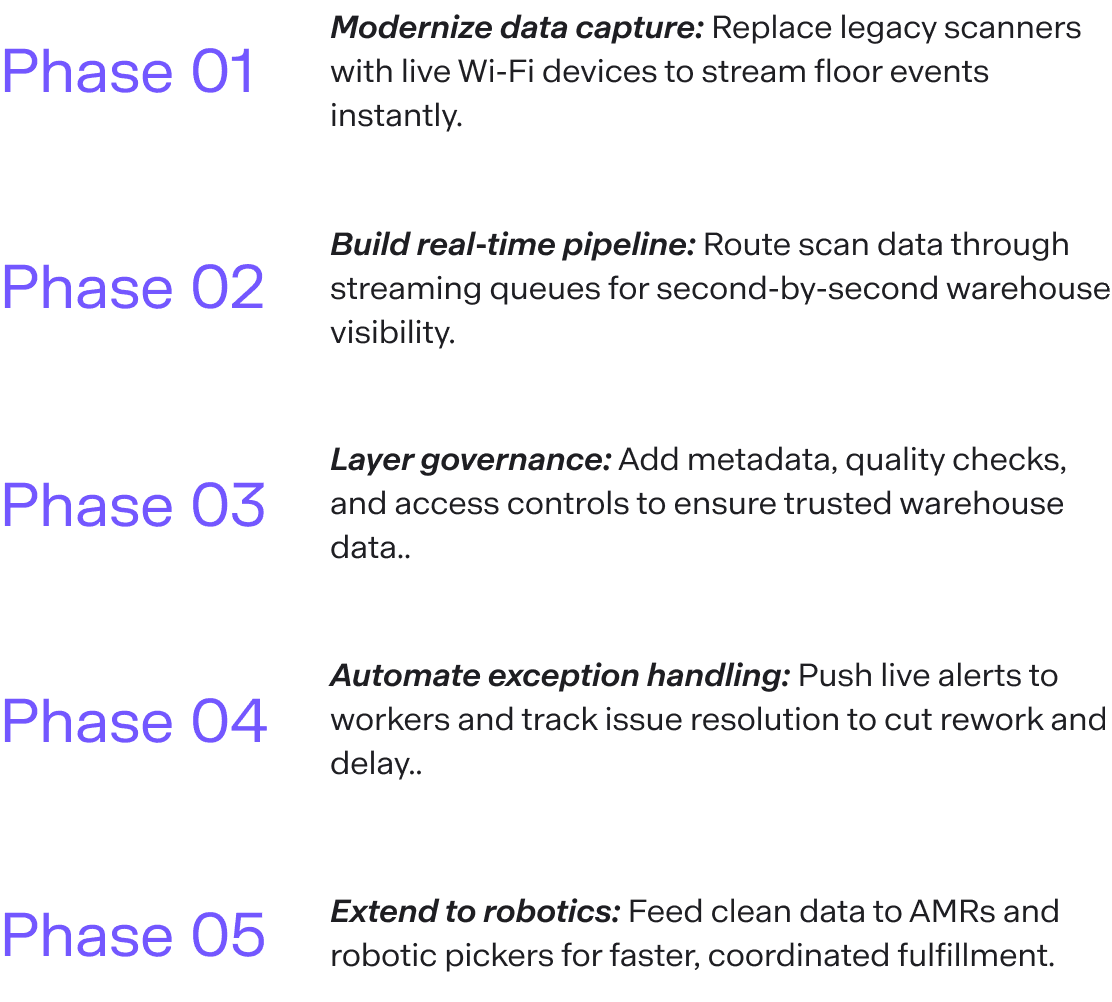
This playbook offers a phased, outcome-first modernization path that connects every upgrade to a measurable result. Each stage enhances throughput, trims walking time, and boosts accuracy while protecting uptime. The outcome is a real-time, governed data foundation that supports robotics, AI, and future-ready fulfillment without disrupting today’s flow.
Why modernization matters now
Warehouse leaders can’t optimize what they can’t see. Paper workflows and legacy scanners delay data, forcing teams to rely on radio calls and manual counts. Missed inventory, idle pallets, and delayed invoices all trace back to stale or incomplete data. Modernization enables real-time visibility, trims labor waste, and strengthens throughput—all without halting fulfillment.
How to execute without disruption
This playbook introduces five sequential stages designed to deliver fast wins. Modernize data capture first, then route events through real-time pipelines. Add governance early to ensure accuracy and compliance. Next, automate exception handling so issues resolve themselves. Finally, connect robotic systems that share the same event stream, scaling throughput without replacing people. Each phase builds on the last and aligns to operational KPIs.
What results to expect
Expect measurable gains—faster dock-to-stock, higher pick accuracy, and reduced walking time. Exception loops close instantly, freeing hours per shift. Reporting shifts from hindsight to real-time action. CIOs prove ROI with metrics finance can verify: lower rework, faster fulfillment, and resilient operations ready for automation.
*based on external research sources cited within.
Access the playbook CIOs use to modernize warehouse management data
Need an executive summary? View our roadmap for data modernization in warehouse management.
FAQs
How should I prioritize data modernization efforts in wealth management?
What are the biggest data risks in legacy wealth systems?
How do I prove ROI on my data platform investments?
What data capabilities do I need to support AI in wealth management?
How can I align compliance, finance, and tech stakeholders around modernization?





Take the brighter path to software development.