Key takeaways
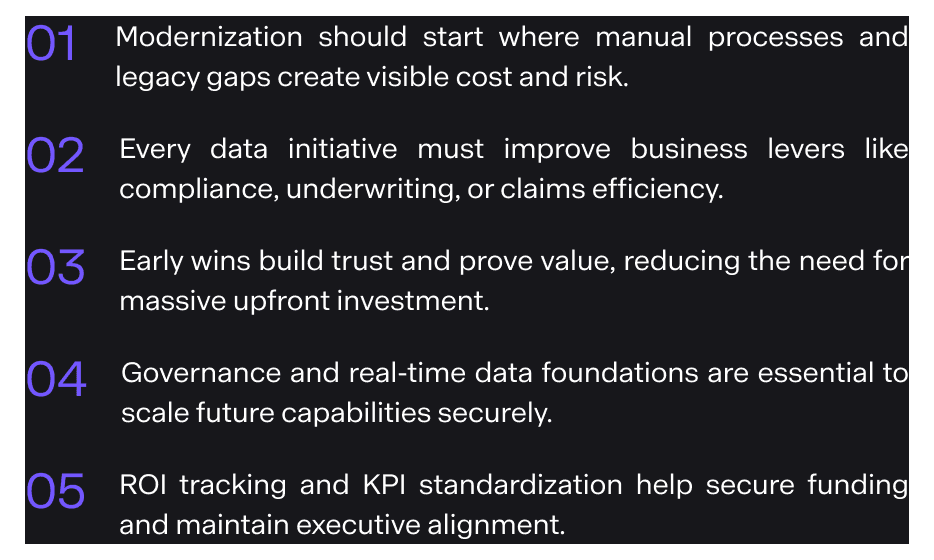
Identify where outdated systems, data gaps, and manual processes increase cost and risk
A discovery exercise exposes the hidden tax on revenue created by stale data and duplicate entries. Research estimates poor data quality drains
20–35 % of operating revenue, a figure that matches insurer experience when spreadsheets govern reconciliation. Loss hides inside re‑keyed endorsements, missed cross‑sell triggers, and emergency report rebuilds during examinations. Attaching costs to each bottleneck proves that doing nothing is the riskiest option.
Map where underwriting rules still rely on batch files, where adjusters copy policy snapshots into local drives, and where finance extracts policy counts from CSVs just to close the books. These touchpoints convert to tangible expenses such as overtime, fines, and customer attrition. When leadership sees that manual endorsement rework alone can wipe out a full point of combined ratio, priorities pivot instantly. The inventory becomes the first value artifact of the roadmap.
Closing the discovery phase with transparent math aligns CIO, COO, and CFO on what modernization must address first. Agreement on the pain list prevents scope creep because new requests must map to documented loss. Audit leaders welcome the clarity because it shows proactive risk control. With shared understanding secured, the program moves to value design.
Tie every data initiative to underwriting accuracy, compliance, and claims efficiency
Modernization succeeds when each release targets a measurable business metric rather than a technical milestone. Underwriters watch hit ratio and quote turnaround, compliance tracks filing exceptions, and claims leaders track closure speed; every feature must push at least one of these levers. When a new service shortens referral queues or removes manual rework from solvency reports, sponsorship strengthens. Business ownership of benefits also keeps IT resourcing disciplined because every sprint must defend its impact.
Start with exposure data feeding catastrophe models and discount curves. Normalizing those feeds cuts underwriting variance and reduces manual referrals that back up senior desks. Next, stream clean policy snapshots into claims so adjusters no longer chase endorsements, lowering call volume and cycle time. Add lineage metadata to compliance dashboards so auditors can trace premium calculations in seconds.
Each linkage shows executives that data improvement is a revenue, risk, and service strategy delivered through software. That narrative transforms funding talks because outcomes speak louder than architecture diagrams. Momentum grows as modernization enters quick‑win delivery. Stakeholders now expect tangible returns, not just infrastructure.
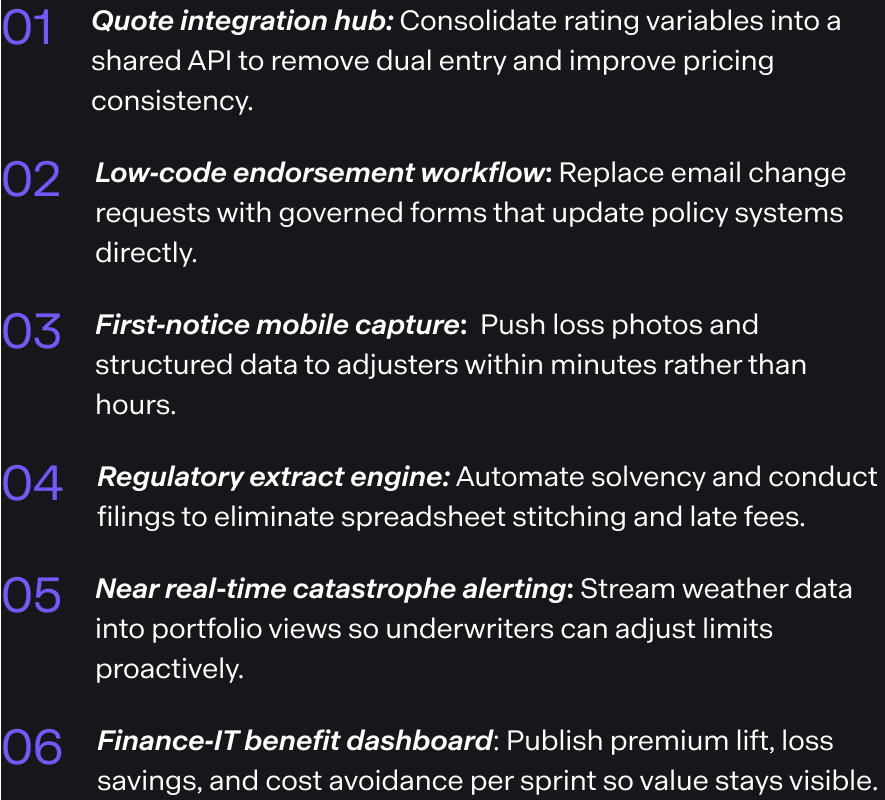
Prioritize early wins with modernization for faster ROI and reduced operational risk
Early victories finance the next sprint and build trust across the enterprise. Selecting use cases with a contained scope, limited dependencies, and a visible customer benefit is therefore critical. Capgemini found
42% of underwriters who adopted targeted AI data clean‑up already quote faster, proving modest interventions pay off quickly. Choose components that can reach production inside one quarter so executives witness change before enthusiasm wanes.
Completing two or three of these slices proves modernization can coexist with daily operations. Teams develop muscle memory around agile governance and release pipelines. Risk managers gain confidence as controls improve rather than erode. With sponsorship solid, deeper integration becomes politically and technically feasible.
Build a foundation that connects policyholder data, claims systems, and risk models in real time
A publish‑subscribe backbone creates a single source of truth the moment any transaction occurs. Capgemini’s data‑powered enterprises study reports
76% of “data masters” modernize integration primarily to scale generative AI, confirming that connectivity now underwrites analytics ambition. Without low‑latency feeds, predictive pricing remains slideware, so real‑time messaging becomes a prerequisite for growth.
Implementation starts with a schema registry so every producer and consumer speaks the same language. Streaming brokers then route policy, claim, and payment events to downstream models in seconds. Security gates inspect payloads at ingress so compliance stays intact, and downstream systems consume authorized views instead of fragile extracts.
Operational benefits appear quickly. Underwriting adjusts accumulations during developing storms, claims prepares adjuster rosters in advance, and finance sees exposure shifts before quarter close. Audit teams replay event logs for sampling instead of requesting screenshots. The foundation supplies risk awareness and customer responsiveness simultaneously.
Need a tactical view? Access our tactical playbook for data modernization in insurance.
Apply governance that supports regulatory compliance, transparency, and automation
Governance must safeguard data while letting delivery teams move quickly. Rules written once should follow data everywhere instead of spawning manual checkpoints. Insurance Journal reports average claim cycle time has
reached 44 days, the longest since 2008, showing how fragmented oversight compounds delays. Embedding controls into pipelines catches issues upstream and accelerates releases.
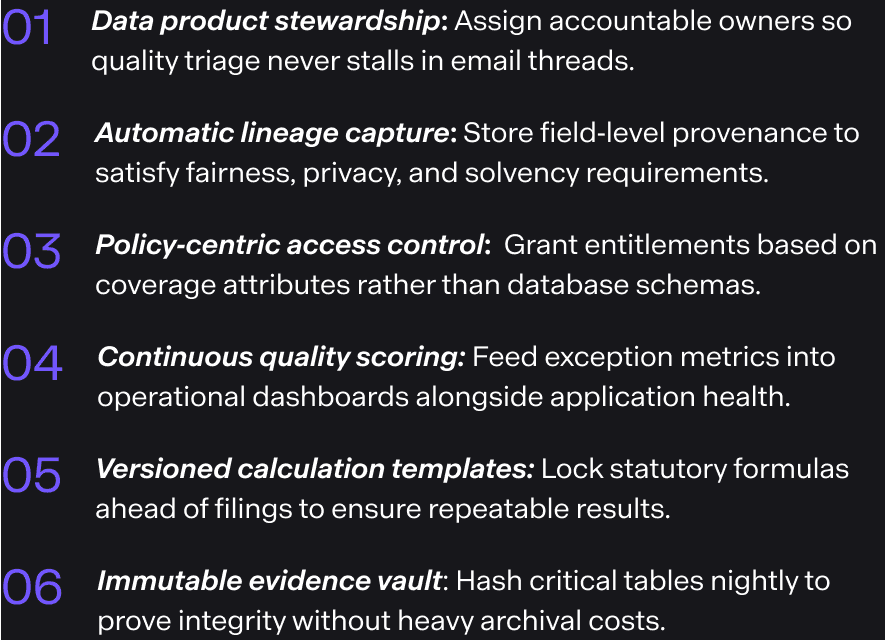
Governance woven into code accelerates releases because controls travel with data. Auditors receive context in hours, not weeks, reducing examination stress. Developers focus on features instead of paperwork. The enterprise moves faster precisely because its guardrails are stronger.
Standardize KPIs across underwriting, claims, and customer experience teams
Teams argue when they measure performance differently, yet all rely on the same transaction facts. A shared metrics catalog removes friction by locking definitions, time stamps, and adjustment rules. Dashboards then pull from one ledger, so debates shift from data integrity to business strategy. CFOs trust forecasts because premium, loss, and expense numbers reconcile automatically.
Organize the catalog around profitability, speed, and resiliency. Profitability covers combined ratio and lifetime value; speed tracks quote turnaround and claim closure; resiliency monitors data quality and latency. Link each KPI to a data contract so lineage stays explicit. When scorecards align, funding talks become outcome‑focused rather than technology‑driven.
Consistent metrics also clarify prioritization. If a small data fix boosts both speed and profitability scores, it jumps the queue. Quantitative focus reinforces the roadmap’s thesis that business value, not platforms, drives modernization. The stage is now set for disciplined benefit tracking.
Track ROI at every step to maintain funding and demonstrate control
Budgets renew when leaders see verifiable returns. Embedding finance analytics into delivery rituals turns anecdotal wins into hard numbers. A low‑code validation study showed automated policy calculation checks cut
manual effort by 92 %, translating directly into savings. Routine evidence shields the roadmap against shifting corporate priorities.
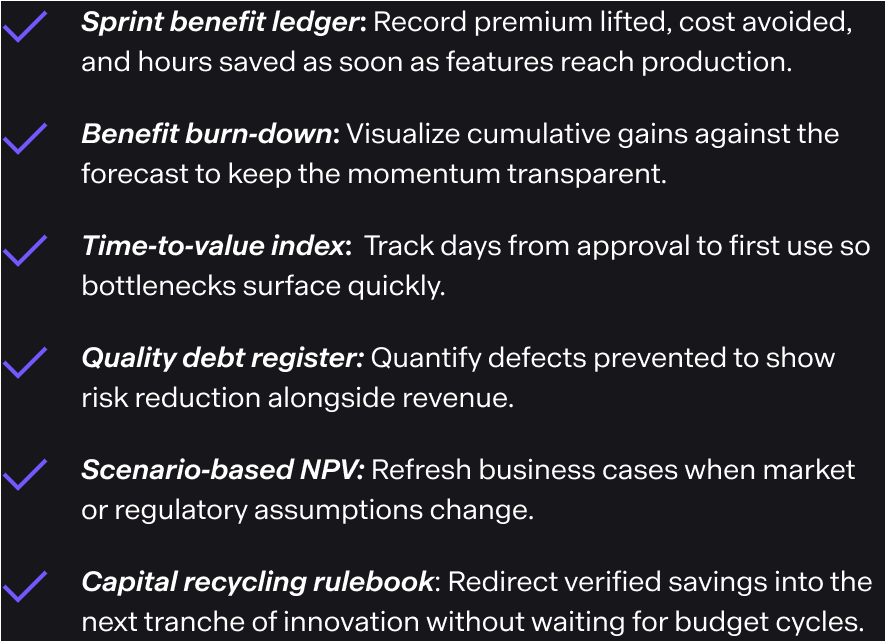
Visible economics strengthens the CIO’s seat at the funding table. Stakeholders trust a plan that acts like an investment portfolio, not a cost center. Risk appetite improves because governance and finance metrics march together. With control demonstrated, attention shifts naturally to sustained execution.
How Lumenalta®helps insurance CIOs modernize data systems without disruption
That focus on sustained execution mirrors the engagement philosophy we bring to client programs. Our architects co‑create sprint benefit ledgers with your finance team, ensuring every release pairs technical delivery with audited impact. Reference patterns accelerate integration without forcing disruptive platform swaps, letting frontline operations continue quoting and settling while foundations evolve. Compliance checkpoints embed automatically so auditors gain confidence alongside developers.
Once early wins surface, we transition ownership to internal squads and step back into an advisory cadence. This approach keeps velocity high while avoiding long‑term supplier dependence. Leadership appreciates a partner that aligns with a cost‑control culture rather than prescribing indefinite outsourcing. You retain momentum, save budget, and carry a proven playbook for whatever priority comes next.