Key takeaways
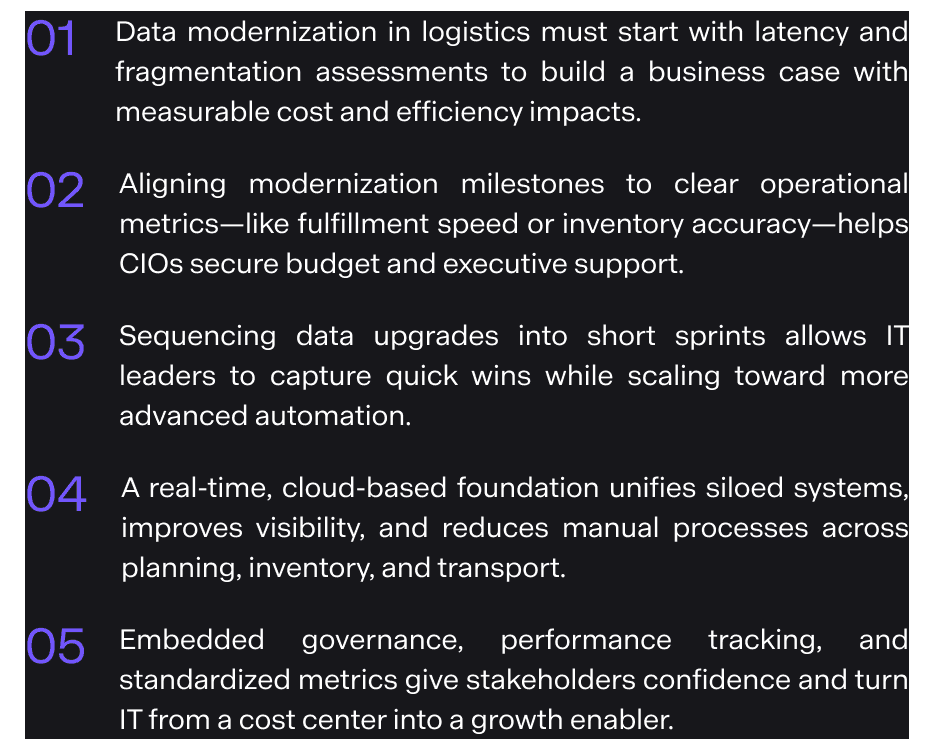
Pinpoint where data latency and fragmentation are costing you money
Legacy transport management systems often push updates overnight, forcing dispatchers to steer with yesterday’s events. Multiple enterprise resource planning, warehouse management, and transport management instances double‑enter orders, inflate inventory on paper, and hide margin leaks. Estimates calculate
132% three‑year ROI after organizations retired similar on‑premises databases in favor of elastic cloud services, citing lower maintenance and near‑zero downtime. The takeaway: measuring where data stalls and how often teams re‑key or reconcile it creates a baseline that justifies modernization dollars.
Supply‑chain CIOs start with a latency heat map that plots how long each record takes to travel from origin to consumption. Unexpected spikes often trace back to manual file transfers or middleware running on hardware that no one dares patch. A second diagnostic counts parallel versions of “inventory available” or “proof of delivery” across systems; every duplicate is a candidate for rationalization. With facts in hand, leaders can assign cost to each minute of delay and each extra copy, turning abstract integration talk into quantified budget lines.
Tie every data initiative directly to margin, service, and speed KPIs
Data strategy earns funding when every milestone connects to an operational metric that the chief operating officer already tracks. Cutting handheld scanner lag in the warehouse trims overtime; removing a day of finance, transport reconciliation accelerates carrier payment discounts. Modeling shows that sharper insights can
reduce logistics spend by 10%, lower costs by an additional 5% through smarter route consolidation, and cut transit lead times by 15%, all without adding assets. When CIOs frame goals in those terms, modernization becomes a margin expansion play instead of an IT expense.
The same logic applies to customer promises. A single source of truth on package location shrinks “where is my order” calls and limits credit notes tied to missed windows. Finance gains clearer landed cost, helping sales quote profitable rates even in volatile fuel markets. Every stakeholder sees the scoreboard move in their column, so executive sponsors stay available when the next phase needs sign‑off.
Prioritize early wins: Sequence your modernization for fast ROI and low risk
Budget holders rarely approve massive rewrites without proof that incremental wins will arrive quickly. The answer is a sequenced backlog that balances fast savings against long‑term platform objectives. Over
80% of enterprises already run workloads across more than one public or private cloud, so modular execution fits existing procurement patterns. A clear order of operations keeps teams focused and prevents technical debt from creeping back in.
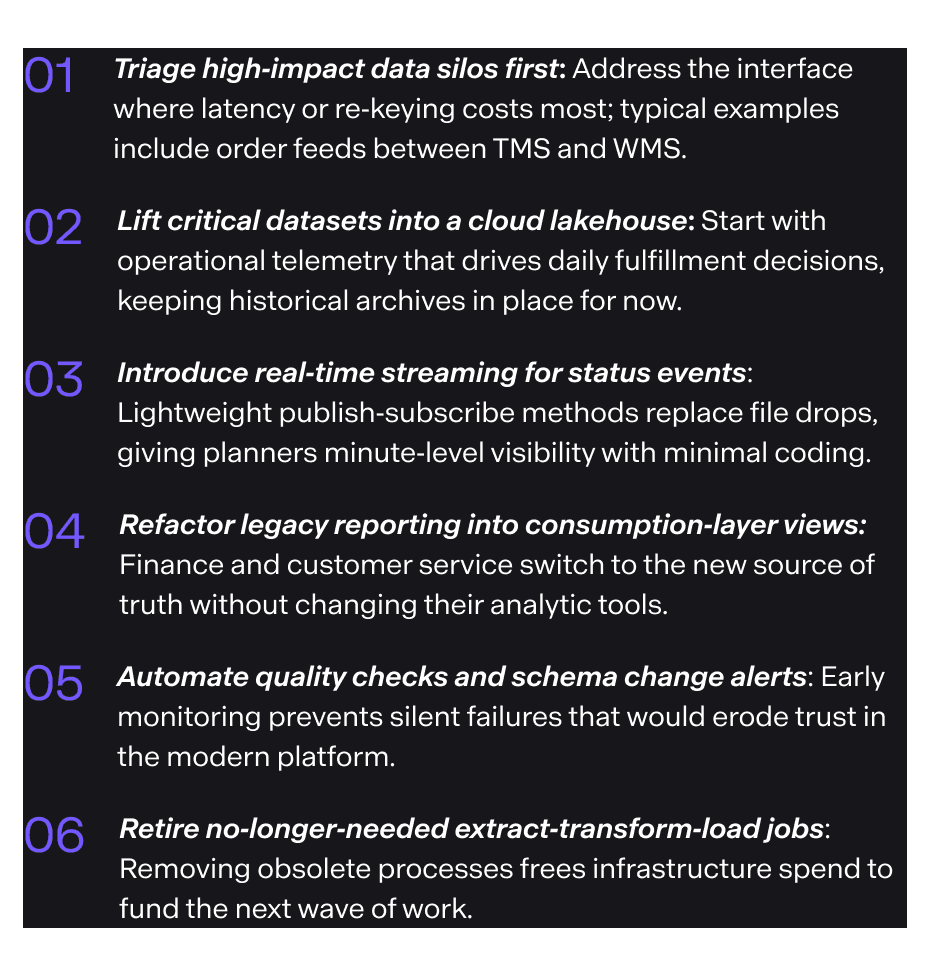
This order delivers tangible wins, less rework, faster tracking, and smaller hardware bills within the first quarter. Each completed step removes complexity that would otherwise inflate the cost of subsequent phases. Teams build muscle memory on small scopes before tackling core financial or compliance data. Most importantly, stakeholders witness progress in operations reports, easing conversations about the next investment request.
Build a real-time data backbone to improve visibility and decision speed
Modern cloud queues and APIs let events flow from demand planning to yard management in seconds, yet many fleets still rely on scheduled file exports. A recent 2024 visibility survey shows that
53% of supply‑chain teams now use Internet of Things trackers for live shipment data, and another 25% plan adoption within a year. Those signals lose value if the platform beneath cannot process them as they arrive. Real‑time integration, therefore, starts with a universal event schema—orders, locations, temperature, status, so new devices or partners plug in without custom development.
The architecture also needs back‑pressure controls so a surge in sensor updates never knocks out billing jobs. A mesh of stateless microservices scales horizontally under load, while a central catalog records contract times, units, and ownership. With that in place, planners can simulate carrier capacity using current data instead of yesterday’s averages, and customer‑facing portals display precise estimated time of arrival rather than wide windows.
Need a tactical view? Access our tactical playbook for data modernization in operations and supply chain.
Embed governance that builds trust and unlocks automation
Trust collapses when multiple spreadsheets conflict or a lookup returns “unknown.” Recent research notes that
97% of enterprise cloud applications are acquired without central sanction, reflecting how fast shadow IT grows when governance lags. Logistics suffers doubly because each unsanctioned system invents its own codes for products, carriers, or facilities. A governance model woven into everyday workflows stops errors before they spread.
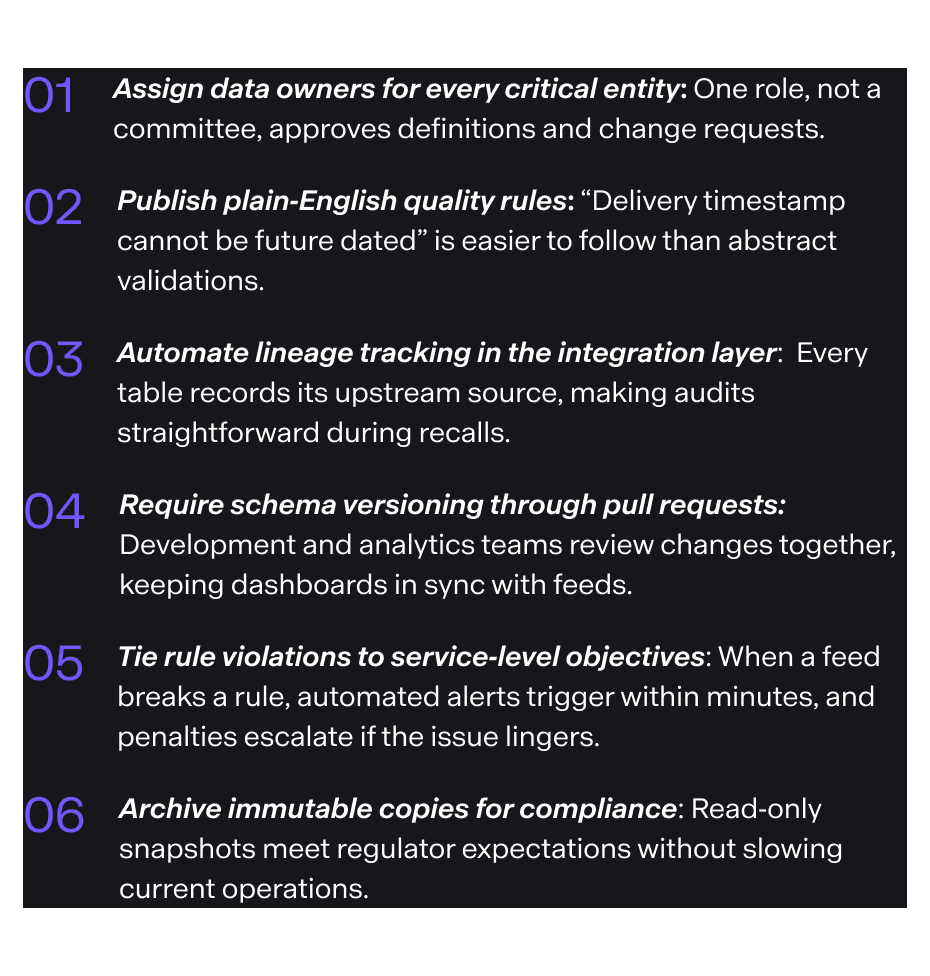
Governance feels slower at first, yet it speeds software release because approvals happen once, not during every crisis. Accurate, lineage‑rich data fuels robotic process automation, voice picking, and delivery bots without human spot checks. Regulators see clear custody trails, cutting audit prep from weeks to hours. Above all, executives gain confidence that the dashboards mirror reality.
Standardize metrics to eliminate finger-pointing and accelerate action
Procurement cares about vendor fill rates, warehouses track pick accuracy, and carriers watch on‑time delivery. When each function calculates metrics differently, executives cannot spot the root cause of margin swings. A unified data model brings every measure, purchase‑order promise date, pallet put‑away time, and last‑mile ETA onto the same calendar and unit conventions. Cross‑functional metrics then reveal that a supplier delay, not a misplaced pallet, explains late delivery, guiding the fix to the correct contract rather than flooding the warehouse with new scanners.
Standard definitions also simplify service‑level agreements with third‑party logistics (3PL) partners. Dashboards refresh against a single SQL view, eliminating email debates over whose clock counts. Finance accesses real‑time accruals when penalties apply, improving cash forecasting. Over time, decision science models train on cleaner inputs, sharpening predictions that keep freight spend and inventory carrying costs inside target bands.
Prove ROI at every step: Track value to unlock ongoing investment
Modernization wins fade from memory unless someone counts the savings. Linking technical milestones to profit‑and‑loss lines keeps sponsors engaged and boards patient. Metrics live in the same data platform they aim to improve, so reporting requires no extra work. Continuous value tracking also flags scope creep before it dilutes returns.
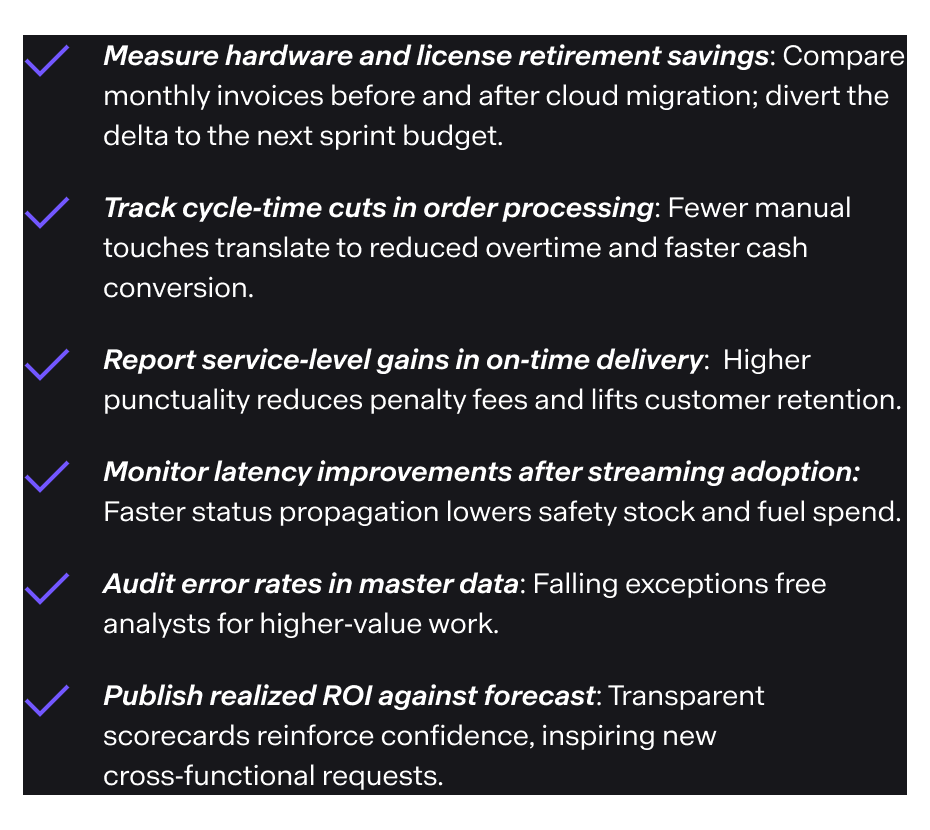
When value dashboards refresh daily, skepticism evaporates. Financial controllers can trace every item on the income statement to a technical change or policy shift. CIOs demonstrate that IT now drives growth rather than reacts to outages. That credibility positions the organization to tackle advanced analytics and generative AI with serious momentum.
How Lumenalta®accelerates data modernization without disruption
Lumenalta® pairs pragmatic architects with logistics operators, mapping quick wins against margin goals before a single line of code is written. Our phased delivery model shifts the most painful data blockage first, then folds lessons learned into a repeatable release cadence that clients describe as “weekly momentum.” Co‑creation workshops convert tribal process knowledge into data contracts, while our lakehouse accelerators spin up schema‑on‑read platforms in hours, not quarters. Clients often reinvest savings from retired servers and manual reconciliations into machine‑learning pilots without expanding budget envelopes.
Governance accelerators embed lineage and quality rules into pipelines so audits never slow freight. Real‑time integration blueprints use open source tooling and cloud‑native messaging, avoiding vendor lock‑in while still meeting sub‑second latency targets. A dedicated value‑office supplies cost‑savings calculators and service‑level trackers that tie each sprint to operating income, reassuring finance that projects will pay for themselves. Finally, our change‑management playbooks equip supervisors and floor managers with role‑specific dashboards that make new data habits stick.