
Scale with data precision
Logistics CIO’s tactical playbook for data modernization in operations and supply chain

Key execution findings
Siloed systems, batch files, and spreadsheet hand offs slow decisions and hide costs across your network. Operators need live signals, not yesterday’s extracts. Full replatforming is costly and risky for time sensitive operations. This tactical playbook shows a phased path that maps every step to measurable KPIs like on time delivery, detention fees, and inventory turns. You get real time visibility, cleaner data, and audit ready records without disrupting the flow of goods.
54%
call fragmented information the top obstacle to end to end visibility in supply chains.*
29%
of supply chain organizations are prepared for future disruptions, underscoring the need for KPI led modernization.*
723B
global public cloud spend forecast for 2025, reflecting the shift to elastic, pay for use analytics at scale.*
42%
higher net income growth reported by data mature firms versus peers when data is captured and shared in real time.*
AUG. 7, 2025
3 Min Read
This playbook lays out a phased, outcome first approach. Each step is tied to specific goals such as faster dock to stock, lower detention, and higher inventory accuracy. You will see progress in weeks, not quarters, while building toward predictive and automated operations. The payoff is a resilient, AI ready foundation that improves margins and customer experience in the same motion.
Why modernization matters now
Compressed delivery windows, volatile demand, and rising compliance obligations expose the limits of batch based, spreadsheet driven operations. When order, inventory, and transportation data live in separate modules, dwell time grows, detention fees climb, and planners overbuy to stay safe. Customer teams copy status between systems, delaying proof of delivery and widening cash cycles. The result is margin erosion and missed SLAs that cannot be fixed with more headcount.
How to execute without disruption
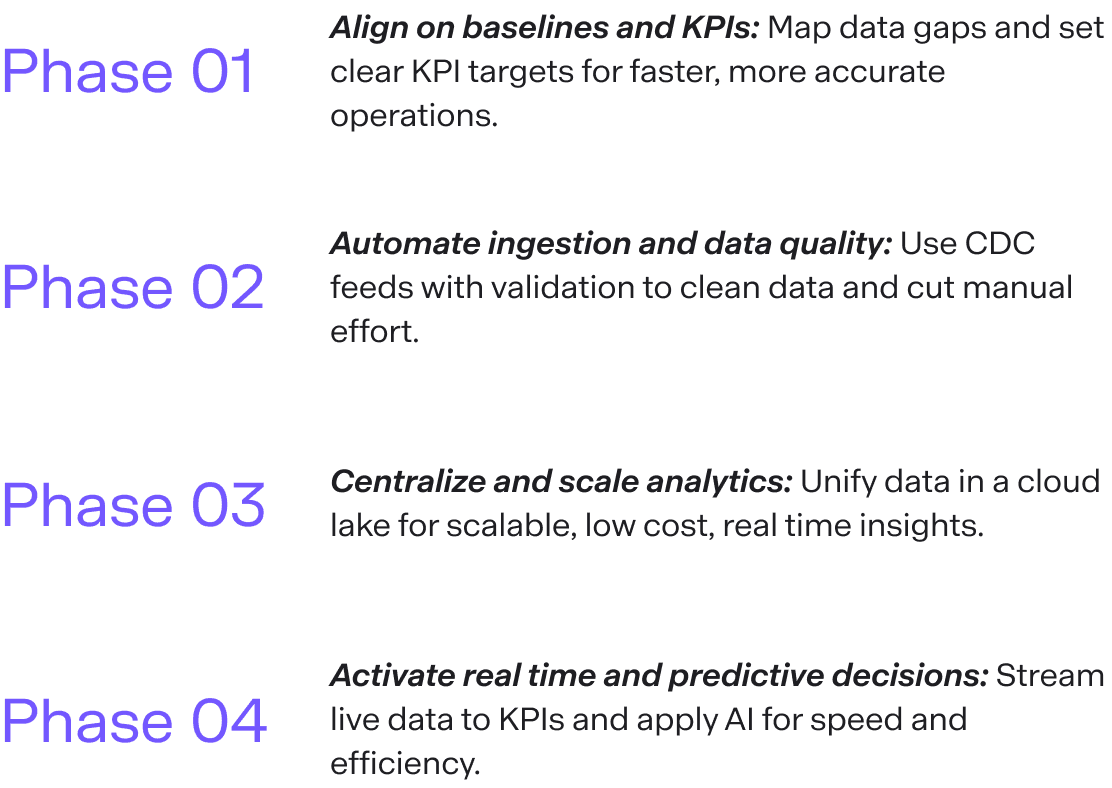
This playbook replaces high risk rip and replace with four practical phases. First, align on baselines and KPIs so every decision ties to outcomes. Second, automate ingestion and data quality across ERP, WMS, TMS, and CRM to eliminate manual exports. Third, centralize analytics in a governed cloud lake that separates storage from compute for elasticity and transparency. Fourth, stream real time events to live KPIs and apply predictive models where they pay back within one peak season.
What results to expect
Expect faster dock to stock, fewer chargebacks, lower detention, and tighter inventory accuracy. Live metrics reduce firefighting and speed exception handling, while automated quality checks cut data defects at the source. Finance sees working capital freed from buffer stock and a shorter order to cash cycle. With trusted, timely data, leaders shift from reactive firefights to proactive planning and establish an AI ready foundation that scales with demand.
*based on external research sources cited within.
Access the playbook CIOs use to modernize logistics data
Need an executive summary? View our roadmap for data modernization in logistics.
FAQs
How can I modernize my logistics data systems without overhauling everything at once?
What’s the best way to unify fragmented logistics data across TMS, WMS, and ERP systems?
How do I prove the ROI of a logistics data platform to my CFO and board?
What risks do I need to manage when giving business users access to supply chain data?
What’s the right sequencing for migrating to an AI-ready logistics data platform?










Take the brighter path to software development.