Key takeaways
Identify where fragmented reporting and manual processes are creating cost and delay
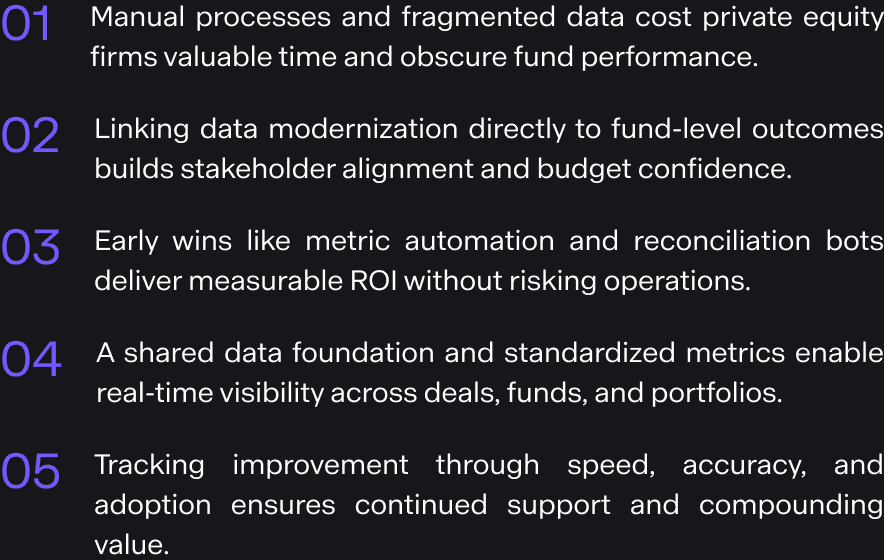
Manual reconciliation hides true costs that rarely appear on a general ledger. Teams wait on emailed spreadsheets, apply fiscal‑year macros, and repeat the exercise fund after fund. Lost hours compound into missed bid windows and slower closes, reducing the internal rate of return even when deal quality stays high. The first step is to expose that operational drag in clear financial terms.
Research shows
73% of professional services firms lack unified financial visibility, wasting 44 hours weekly on discrepancy fixes. Month‑end chaser emails create the same drag in private equity. Every restated spreadsheet pulls senior analysts into clerical work and hides emerging risk. Counting those hours and salaries frames modernization in investment language.
Once cost baselines are visible, resistance to change falls because stakeholders finally recognize the drain. CIOs gain license to target the worst friction points rather than arguing for wholesale system swaps. This factual grounding steers modernization toward tangible savings instead of abstract efficiencies. With consensus on what fragmentation costs, the program can proceed to connecting data work directly to fund value.
Link data initiatives to fund performance, reporting quality, and risk visibility
Stakeholders care less about technology choices than about cash distributions and audit opinions. Connecting data tasks to observable fund metrics converts technical language into investor outcomes. When teams understand how a metadata catalog cuts audit cycle time or how an integration layer speeds quarterly letters, sponsorship grows. Mapping each initiative to value creation, protection, or acceleration keeps the roadmap focused on results.
A Capgemini research report found that
40% of wealth managers struggle to source reliable ESG impact data.
Private equity sees similar pain when limited partners request deeper KPI transparency. Mapping each data task to IRR, MOIC, or covenant risk ensures budget flows to efforts that move fund performance, not vanity dashboards.
Linking initiatives to outcomes eases budget approvals because every line item references a measurable fund objective. The approach prevents scope creep by discarding tasks that lack direct performance impact. It also clarifies success criteria in advance, avoiding retroactive justification exercises. With outcomes attached, modernization becomes a portfolio management lever rather than a cost center.
Prioritize early wins: sequence your roadmap for fund‑level ROI and operational control
Early victories prove the concept, free budget, and build trust across finance, risk, and deal teams. Sequencing those wins requires balancing technical low‑hanging fruit with areas that move headline numbers that investors notice. Start simple, but ensure every milestone leaves behind reusable capability instead of point solutions.
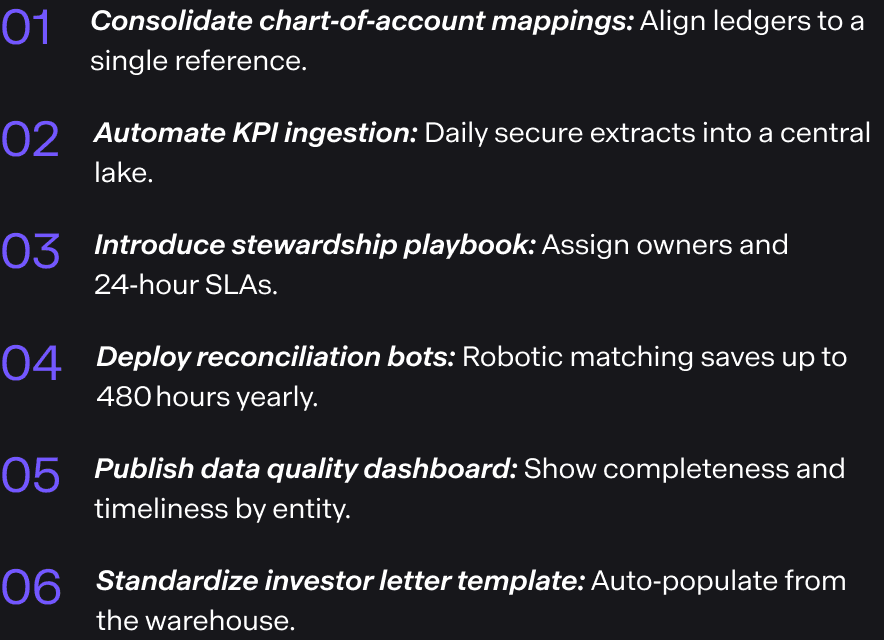
Each step delivers a visible improvement while setting the stage for more ambitious initiatives such as predictive performance analytics. Because both impact and ease order tasks, the program gains momentum instead of hitting resistance. Weekly reporting of hours saved and error reductions turns anecdote into evidence that convinces skeptical partners. With momentum secured, the roadmap can expand to the connected foundation that removes silos outright.
Build a connected foundation for deal, fund, and portfolio data visibility
Modernization falters when integration patterns differ for every portfolio company or asset class. A connected foundation replaces brittle point‑to‑point feeds with reusable interfaces and shared context. That foundation rarely demands ripping out existing ERPs or data marts; it layers lightweight connectors and a governed warehouse on top. Once information moves through a single pipeline, visibility improves without disrupting the quarterly close.
One Gartner study reports that
59% of organizations do not measure data quality, leaving leadership blind to systemic issues.
Private equity CIOs counter this risk by anchoring the foundation on canonical data models with field‑level quality flags. Streaming ingestion with change tracking lets the office of the CFO compare provisional and booked values instantly, understanding error bands in real time. Meanwhile, a semantic layer translates warehouse objects into terms that deal teams trust, removing the spreadsheet translation tax.
Building this foundation early avoids the later expense of reconciling multiple marts or retrofitting governance. It also accelerates subsequent initiatives because every new metric inherits lineage and security controls automatically. Stakeholders experience faster ad hoc analysis since the underlying joins are already mapped. Most importantly, the organization gains a single source of truth against which every portfolio CEO can align.
Need a tactical view? Access our tactical playbook for data modernization in private equity.
Apply governance that improves reporting accuracy and simplifies audits
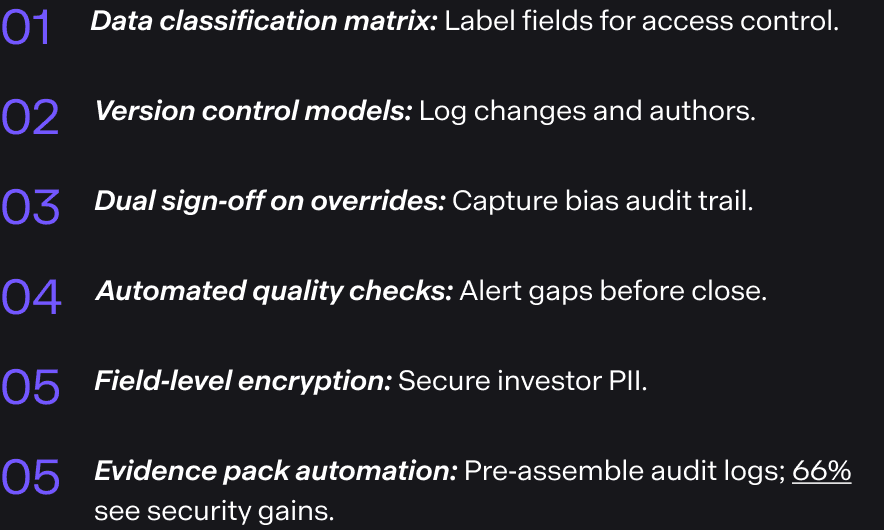
Governance should feel like a safety net, not a police force. Designing controls that improve reporting accuracy while simplifying audits satisfies regulators and accelerates exits. Well‑chosen policies protect value without stifling portfolio innovation.
These controls build trust by making accuracy observable and repeatable. They also replace last‑minute audit sprints with ongoing readiness, sparing teams from disruptive fire drills. Because governance artifacts are embedded in the data pipeline, they scale as new assets join the fund. With compliance embedded, the roadmap can shift focus to metric standardization.
Standardize metrics across portfolio companies, fund ops, and investor reporting
Metric sprawl undermines comparability, diluting the insight modernization seeks to offer. Standardizing definitions turns disparate measures into a common language that supports portfolio steering. The work starts with pinpointing which indicators drive value creation levers such as revenue growth, cost takeout, or cash conversion. Clarity here allows apples‑to‑apples analysis across geographies and industries.
Dimension tables should anchor metric design so that each figure (gross margin, churn, working capital) references identical logic regardless of the source system. Publishing the metric library to portfolio CFOs and deal leads sets transparent expectations and forces conversations about local deviations before a close approaches. When metrics feed both board decks and covenant monitoring, credibility improves because there is no second set of numbers. Consistent metrics also streamline fundraising decks, shortening diligence because buyers trust the data lineage.
Standardization converts modernization from an IT exercise into a firm‑wide performance lens. As confidence rises, teams model scenarios faster and adjust course before market swings erode value. That foresight supports premium exits by proving operational improvements with trusted data. With shared metrics in place, leadership can measure modernization progress itself with the same rigor it applies to portfolio companies.
Track impact at each phase to reinforce confidence and secure reinvestment
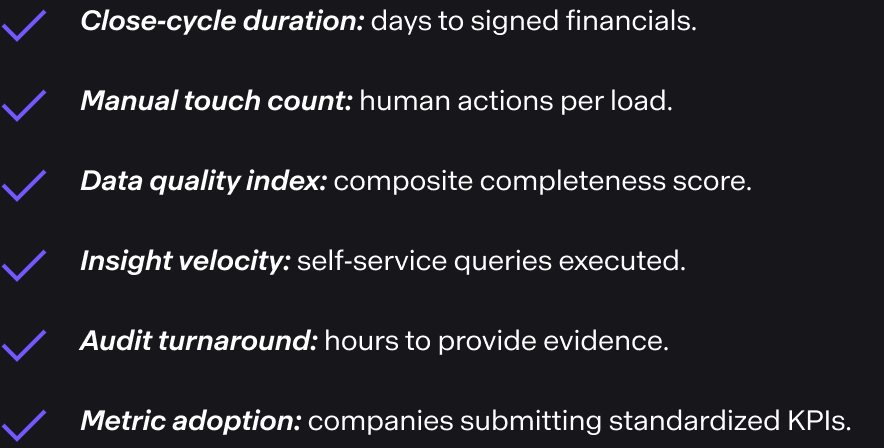
Accountability keeps the modernization engine running even when market turbulence shifts attention. Tracking impact at every phase secures reinvestment by showing that earlier bets paid off. Measures must cover speed, cost, and insight quality, not just system uptime.
Publishing these numbers monthly keeps sponsors informed and expectations realistic. Positive trends support additional budget without new business cases for each phase. If indicators stall, the dashboard highlights where coaching or tooling needs attention before problems spread. Consistent measurement, therefore, protects momentum and shields the program from shifting priorities.
How Lumenalta®helps private equity CIOs modernize faster without disruption
With impact metrics in place, many leaders ask how to accelerate the schedule without disrupting critical closings.
Lumenalta® answers by embedding data architects beside fund controllers and deal analysts from day one. We focus on weekly value increments, delivering integration accelerators, governance templates, and metric libraries that fit your existing tool stack. This approach keeps distribution notices on schedule while modernization progresses.
Our role is to preserve operational confidence while moving you from spreadsheet stitching to real‑time portfolio intelligence. Because the roadmap stays tied to fund economics, every sprint targets measurable improvements in speed, cost, or insight quality. You retain control of strategic outcomes; we supply patterns that shorten time to value. Those elements turn data modernization from a perceived risk into a proven engine of portfolio growth and investor satisfaction.