

What is data security?
NOV. 19, 2026
6 Min Read
Data security is the set of controls that keeps company data confidential, accurate and available to the right people, and AI workloads now decide where those controls have to sit.
The definition hasn't changed much in 20 years. You protect data from unauthorized access, corruption and loss across its whole life, from creation to deletion. What has changed is who reads it. Models, copilots and AI agents now query the same warehouses, documents and customer records your people use, often faster and at far greater volume. Losses reported to the FBI's Internet Crime Complaint Center reached $20.877 billion in 2025, a 26% increase on the previous year.
That pressure makes the old perimeter model too thin. Data security has to travel with the data itself and with the identity behind every request, from an analyst or from an agent.
Key Takeaways
- 1. Data security keeps information confidential, accurate and available, and AI workloads add new readers, new copies and new paths out of the company.
- 2. Agents should see only what the person they act for can see, with identity pass-through, masking and approval before any write or external send.
- 3. Data security management is a fixed cadence of classification, ownership and access review that catches stale agent permissions before they cause a breach.
Data security defined for enterprises using AI
Data security is the practice of protecting digital information from unauthorized access, corruption and theft throughout its lifecycle. For an enterprise using AI, it also covers what models and agents can read, what they can write and what they can send outside the company. The goal stays the same, but the number of readers grows.
A bank's customer table shows the shift. Ten years ago, the main readers were a few reporting tools and the analysts behind them. Today the same table might feed a fraud model, a service copilot and an agent that drafts account letters. Each one is a new reader that needs its own limits.
The core types of data security controls
Data security controls fall into a few core types, including access control, encryption, masking, monitoring and backup. Each protects a different property of the data. Strong programs layer them, so a failure in one control doesn't expose everything behind it.
"Each one is a new reader that needs its own limits."
| Control type | What it protects against | How AI workloads change it |
|---|---|---|
| Access control | People and systems reading data they aren't cleared to see | Permissions have to follow the user's identity through every agent request |
| Encryption | Data exposed in storage or in transit if systems are breached | Embeddings and vector stores need the same encryption as source tables |
| Data masking | Sensitive fields such as account numbers showing up in results | Masks must apply before data reaches a prompt or a training set |
| Monitoring and audit | Misuse going unnoticed until after the damage is done | Logs must capture each model or agent call alongside the person behind it |
| Backup and recovery | Data lost to ransomware, corruption or accidental deletion | Recovery plans need to cover feature stores, indexes and agent memory |
Encryption and backup are well understood in most companies. Masking and monitoring are where AI introduces the most new work, because prompts and model outputs create copies of sensitive data that older tools never see.
How AI workloads change data security risk
AI workloads change risk by creating new copies of data, new readers and new paths out of the company. A prompt can carry customer details to an external model. A retrieval index can hold a copy of a confidential document. An agent can act on data at a speed no human reviewer will match.
The cross-border exposure is already large enough to forecast. Gartner predicts more than 40% of AI-related data breaches will be caused by the improper use of generative AI across borders by 2027. That figure points to a practical problem. Employees paste data into tools hosted in other regions, and the company loses track of where that data now lives.
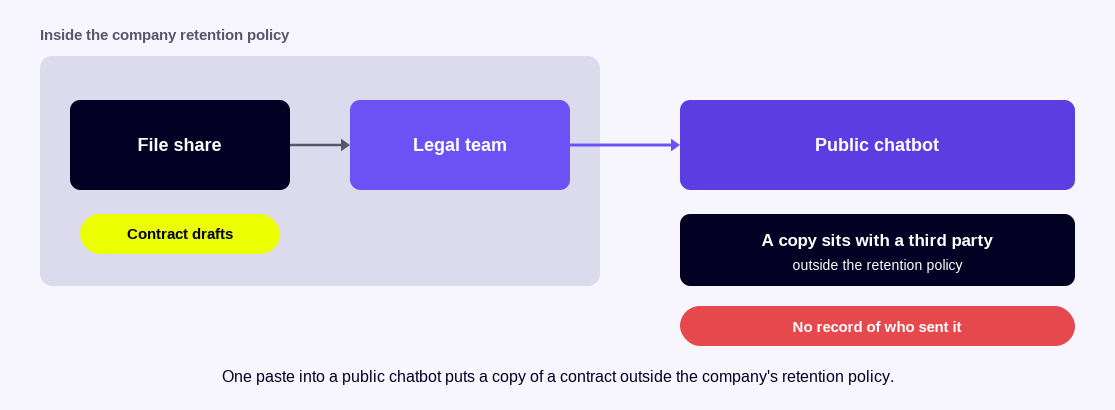
Consider a legal team that drops contract drafts into a public chatbot to summarize them. The contracts never left the company's file share before. Now a copy sits with a third party, outside the company's retention policy, with no record of who sent it.
Securing data that AI agents can read and act on
Securing data for AI agents starts with one rule. An agent should see only what the person it's acting for is allowed to see. That means passing user identity through to the data platform, applying row and column policies there and requiring approval before an agent writes, deletes or sends data externally.
Agents should be treated as privileged actors, with tight controls on what they do with sensitive data. In data security terms, that means tags on sensitive columns, owners for each dataset and policies that apply the same way to a person and an agent. An HR agent built this way can answer a manager's question about team headcount without ever returning salary fields.
Data security posture management helps at scale. It scans your estate for sensitive data that's exposed, untagged or reachable by more identities than it should be, which matters once dozens of agents share the same platform.
Data security management as an ongoing practice
Data security management is the ongoing work of classifying data, assigning owners, reviewing access and testing controls. It isn't a project with an end date. New tables, new models and new agents arrive every month, and each one changes who can reach what.
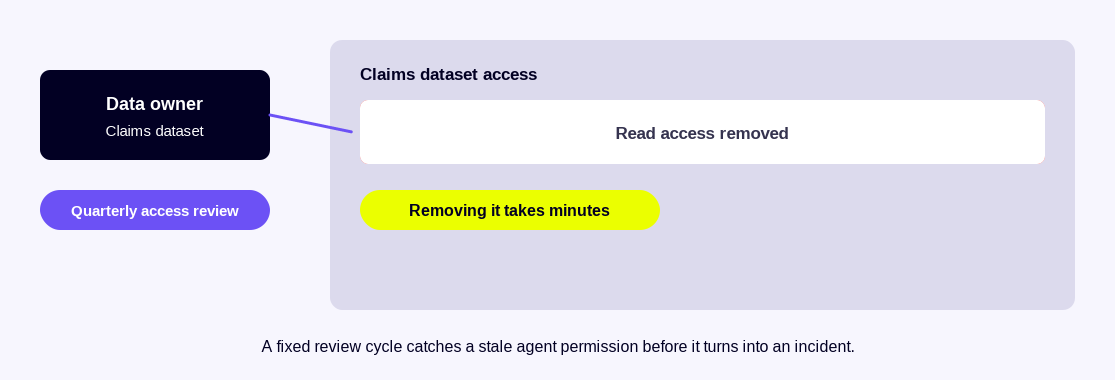
A quarterly access review shows how this works in practice. The data owner for a claims dataset sees that a pilot agent from last year still holds read access, even though the pilot ended. Removing that access takes minutes. Finding it without a review takes a breach.
The cadence matters more than the tooling. Teams that review access, tags and agent permissions on a fixed schedule catch drift early. Teams that review only after an incident end up rebuilding trust with regulators and customers at the same time.
Ownership is what makes the cadence stick. Each dataset needs a named person who approves new readers, including agents, and answers for the controls on it.
Where to start strengthening data security this year
Start with the data your AI workloads already touch, then work outward. Most companies don't need to secure everything at once. They need to know which sensitive datasets models and agents can reach today and close the gaps on those first.
"Removing that access takes minutes. Finding it without a review takes a breach."
- Inventory every model, copilot and agent that reads company data
- Tag sensitive columns and apply masking before data reaches a prompt
- Replace shared service accounts with identity pass-through for agents
- Log each AI request with the user, the data touched and the output
- Set a fixed review cycle for access held by models and agents
When Lumenalta®takes on this work, specialist teams and agents start with the datasets that live AI workloads touch, so the first fixes land where the exposure is real.
Holding data security to the same standard as delivery
Data security holds up when it's built into how data and AI systems are delivered, instead of reviewed after they ship. Controls designed alongside the pipeline, the model and the agent are cheaper to run and harder to bypass than controls added later.
That standard asks for patience early and pays back for years. Every new agent that inherits tagged, masked and owned data goes live faster, because the security questions were answered before it was built. Lumenalta® works with governance built in, embedding decision traceability and compliance controls in delivery, so each new AI workload starts on data that's already protected.
Table of contents
- Data security defined for enterprises using AI
- The core types of data security controls
- How AI workloads change data security risk
- Securing data that AI agents can read and act on
- Data security management as an ongoing practice
- Where to start strengthening data security this year
- Holding data security to the same standard as delivery
Common questions about data security
What is the primary goal of data security?
How does data security differ from data privacy?
What are the most common threats to data security?
How do businesses comply with data security regulations?
Why is zero trust security becoming more popular?
See how data security built into delivery lowers cost and improves data agility.