
Scale with data precision
Tactical playbook for sports media CIOs to modernize data without disrupting live ops

Key execution findings
Every missed stat or mispriced sponsorship leaves money on the table. Rights, audience, and content data live in silos that weren’t built for today’s cross-platform reality. You don’t need a new monolith—you need a phased path that aligns existing tools and maps each step to KPIs. This tactical playbook shows how to normalize rights, unify audience signals, and enrich metadata without disrupting live production. Sequenced change turns fragmented data into faster make-goods, verified reach, and dynamic inventory pricing.
$56.61B
global sports media rights projected for 2025, raising stakes for utilization.*
$29.25B
U.S. rights spend in 2025, demanding accurate fulfillment and proof of reach.*
57%
viewers encounter buffering or quality issues during live streams, risking delivery.*
$654,200
three-year cost hit from manual entry and poor integration in typical orgs.*
SEP. 11, 2025
3 Min Read
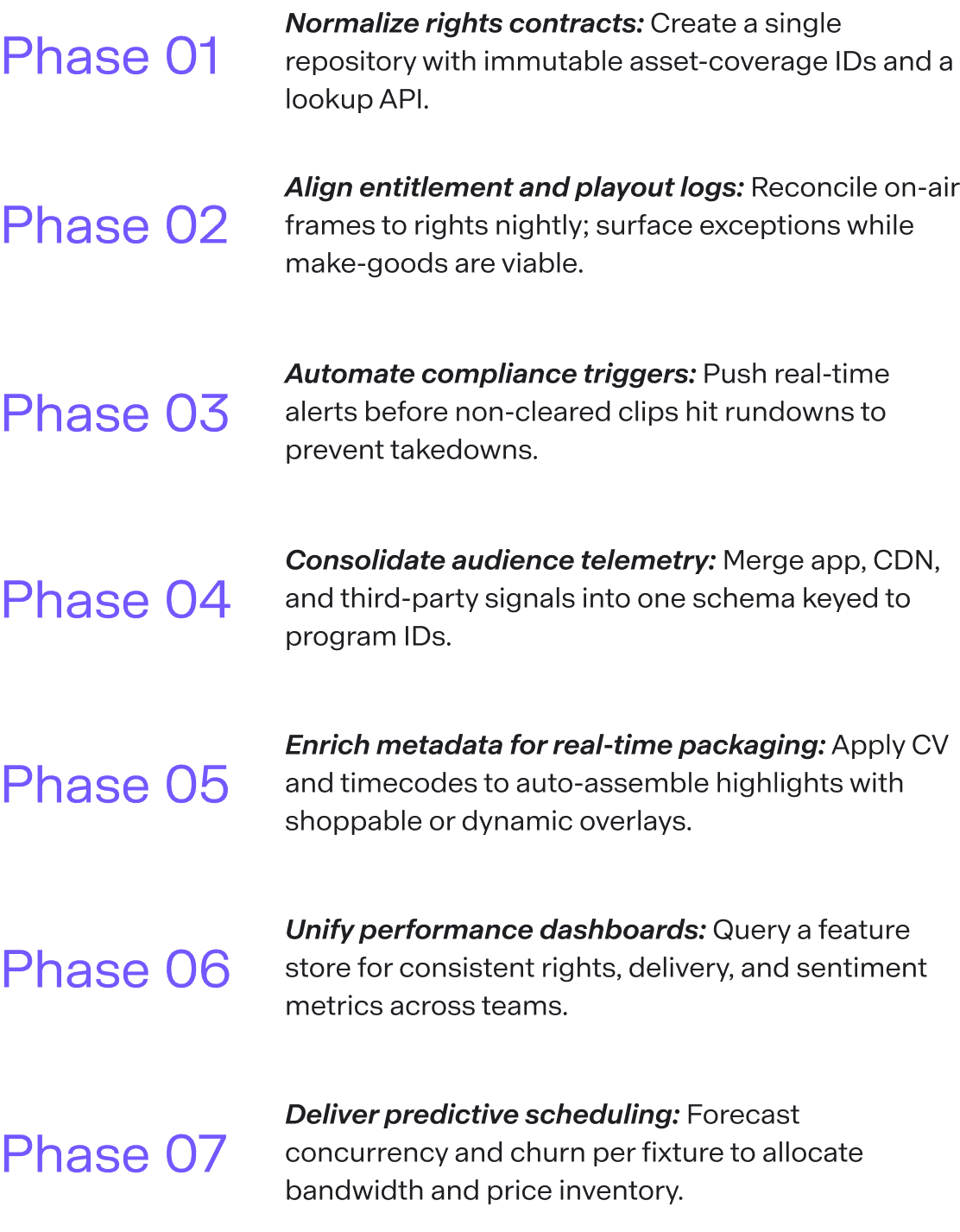
This playbook lays out a phased, outcome-first path that keeps trucks rolling and streams live. Each phase is tied to monetization and cost KPIs—rights utilization, sponsorship delivery, engagement velocity—so finance sees value immediately. Start with contract ground truth, then align playout and entitlement, unify audience telemetry, and enrich metadata for real-time packaging. The result is a data layer that supports predictive scheduling and premium pricing without slowing production.
Why modernization matters now
With global rights climbing and streams spanning linear, OTT, and social, revenue follows whoever proves entitlement and audience first. Fragmented IDs inflate reach, unstructured metadata delays clips, and manual reconciliations exhaust staff during dense calendars. Performance risk hides in these gaps until it becomes missed SLAs, make-goods, and write-downs. Modernization must protect live operations while turning messy data into monetizable proof.
How to execute without disruption
Sequence change around cash flow. First, normalize rights contracts into a single ID system; then reconcile playout to entitlements so exceptions are fixed overnight, not next quarter. Add policy-as-code alerts that stop non-cleared assets pre-air. Unify audience telemetry into one schema keyed to the same program IDs, and enrich feeds with structured markers so highlights and dynamic assets publish near-live. Replace CSV exports with a feature store and shared dashboards, and finish with predictive scheduling to price inventory and allocate capacity ahead of spikes.
What results to expect
Expect higher rights utilization, faster sponsorship delivery, and shorter engagement lag. Make-good rates fall as exposure is verified in real time, and sales win premium bids with proof on screen. Analysts move from stitching spreadsheets to optimizing content and pricing. Finance sees margin discipline via cost observability, while legal trusts automated lineage and audits. The net: a governed, real-time data foundation that grows revenue without interrupting live ops.
*based on external research sources cited within.
Access the playbook CIOs use to modernize sports media data
Need an executive summary? View our roadmap for data modernization in sports media.
FAQs
How do I modernize data operations in sports media without breaking live broadcast systems?
What’s the best way to improve audience insights in fragmented sports media platforms?
Why is data reconciliation so slow in my sports media business?
How can I prove ROI on sports media data modernization efforts?
What does a scalable data foundation look like for modern sports media?





Take the brighter path to software development.