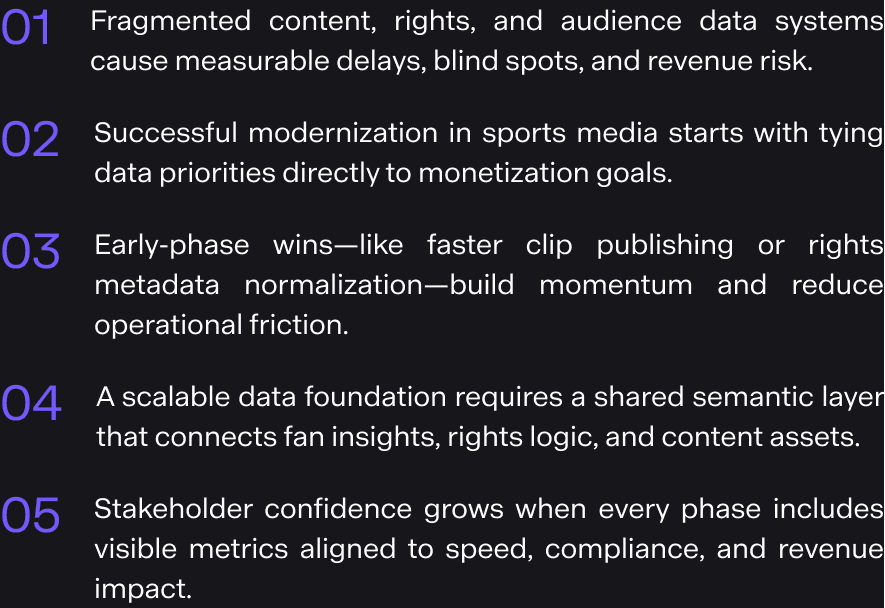
Key takeaways
Identify where disconnected content, rights, and audience systems are creating delays and blind spots
Disparate systems follow different clocks, ID formats, and storage rules. A highlight cut might live in one asset manager while its rights details sit elsewhere, forcing staff to chase spreadsheets during a tense timeout. Audience platforms add a third set of identifiers, breaking any hope of a unified view. Latency creeps in because every question triggers three queries and a guessing game about which answer is correct.
Rights teams rely on precise window times, yet that metadata rarely flows intact from scheduling tools into live‑stream encoders. When a producer trims injury‑time minutes, contractual clocks stay unchanged, creating payout disputes and end‑of‑season reconciliation sprints.
Fragmentation hurts fan insight even more. Executives cannot tell if a spike in mobile views reflects overseas audiences or local fans switching screens, because profile data is duplicated across legacy CRM and over‑the‑top apps. Research found that
38 % of executives cite siloed systems and fragmented customer data as the biggest barrier to seamless experiences.
Pinpointing where critical data stops traveling is the first modernization task. Catalog every hand‑off across content, rights, and audience workflows to surface the worst delays. Share findings with finance and commercial leads to agree on which blind spots cost the most. Those shared pain statements anchor the phases that follow.
Tie data priorities to revenue acceleration across content packaging, sponsorship, and fan engagement
Priorities only stick when tied to cash. Sports media monetization now stretches across linear feeds, streaming bundles, social clips, and on‑site activations. Each line of business depends on rapid, accurate data to price inventory and prove value to partners. Mapping modernization tasks directly to revenue triggers aligns IT and commercial calendars.
Start with content packaging. Unified metadata lets editors snap together alternate angles and historical clips into premium collections. When a tennis match overruns, unused interviews become mobile‑first bites rather than cold storage artifacts.
Sponsorship also benefits. One study reports that
93 % of executives see improved data collaboration as critical to increased revenue growth. When rights details, audience segments, and performance outcomes reside in the same lake, sales teams can offer dynamic pricing based on expected reach instead of outdated averages.
Joined‑up identifiers enable push notifications to invite viewers to replay decisive plays seconds after they happen, driving repeat sessions that raise ad impressions. Each win stems from data priorities that unlock immediate dollars rather than abstract future capabilities.
Connecting modernization work to topline opportunities changes the debate from cost to growth. Business leaders see why a schema change beats another marketing blast. Technical teams gain air cover because their backlogs fund themselves. Sequencing those wins early keeps momentum high.
Prioritize early wins: sequence modernization to support revenue, speed, and compliance
Incremental delivery de‑risks projects that must coexist with sold‑out schedules. Sequencing begins with tasks that shorten obvious delays and surface new metrics. Each deliverable should land inside a broadcast cycle so leaders witness benefits before approving wider change. Early momentum funds deeper refactoring without headline panic.
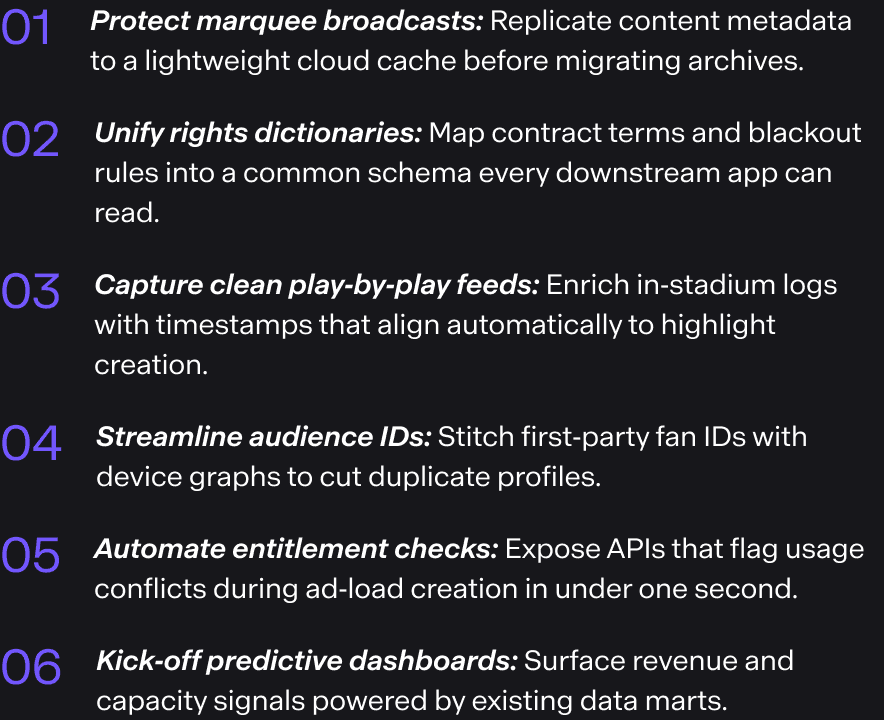
Leaders see speed when highlight clips are published faster and disputes are resolved sooner. Compliance teams relax because contract logic moves upstream. Developers gain confidence as each win hardens the shared data model. That confidence fuels the foundational work next.
Build a foundation that connects rights data, content metadata, and fan analytics
After early gains, the program turns to plumbing that supports every future use case. The goal is a single semantic layer where content objects, contractual rights, and audience behaviors link through shared keys. Pipelines must ingest streaming‑scale telemetry without rewriting existing broadcast automation. Designing for both batch and real‑time access avoids rework as ambitions grow.
Begin with a canonical ID strategy. Content assets receive immutable identifiers that survive trimming, caption updates, and regional edits. Rights agreements and ad creatives reference those same IDs, ending email chains triggered when file names drift.
Modern pipelines then push those enriched objects into an event mesh that feeds analytics at the speed of play. A study notes that
69 % of data decision makers are increasing spending on management and analytics despite tighter budgets. That investment only pays off if the underlying model delivers trustworthy context across every query.
A sturdy foundation cuts hand‑offs while opening room for experimentation. New products sit on top rather than hacking around gaps. Risk drops because contract terms travel with each clip automatically. Governance now has a surface to attach policy without slowing editors down.
Need a tactical view? Access our tactical playbook for data modernization in sports media.
Apply governance that supports compliance with entitlements, partners, and usage contracts
Reliability collapses if rules trail behind data flows. Governance must live inside pipelines, not on exported reports. Sports rights complexity makes manual policing impossible when feeds refresh every second. Embedding policy early prevents accidental breaches that void cashback deals.
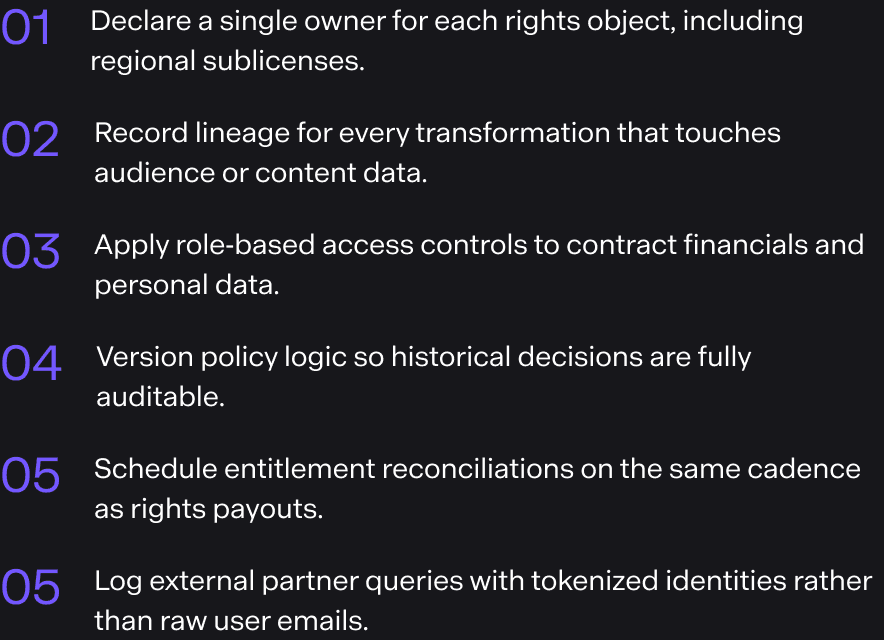
Capgemini research shows
62 % of organizations hesitate to scale data initiatives because of security and privacy threats. Automating controls inside shared pipelines tackles that hesitation head‑on. Auditors get instant evidence while teams keep working. Compliance shifts from gatekeeper to accelerator.
Standardize metrics across content ops, ad sales, and sponsorship teams
Modern data lakes still fail if teams argue about definitions. Sponsorship managers measure reach differently from digital ops calculate unique viewers, creating circular reviews that drain patience. A shared metric catalog ends those meetings and lets dashboards roll up to board‑level KPIs instantly. Harmonized metrics also accelerate AI experiments because models learn from consistent signals.
CIOs should convene content, ad, and finance leads to agree on a handful of key measures, such as match-start availability, mid-roll sell-through, and fan lifetime value. The data team then encodes each definition in code, rather than using slide decks, and publishes lineage diagrams to resolve disputes quickly.
Publishing the catalog in a searchable portal further cuts confusion. Boards get apples‑to‑apples reporting across linear, streaming, and social properties, strengthening investment cases for new rights packages.
Aligned metrics give transparency that keeps modernization budgets intact. Stakeholders stop comparing apples to oranges and start discussing growth levers. Analysts spend more time forecasting instead of reconciling. That clarity paves the way for proving value across phases.
Track value at every step to build stakeholder confidence and improve executive reporting
Modernization only scales when progress stays visible. Weekly demos impress developers, yet executives want bottom‑line proof. Linking each phase to numbers that matter creates a feedback loop of confidence and funding.
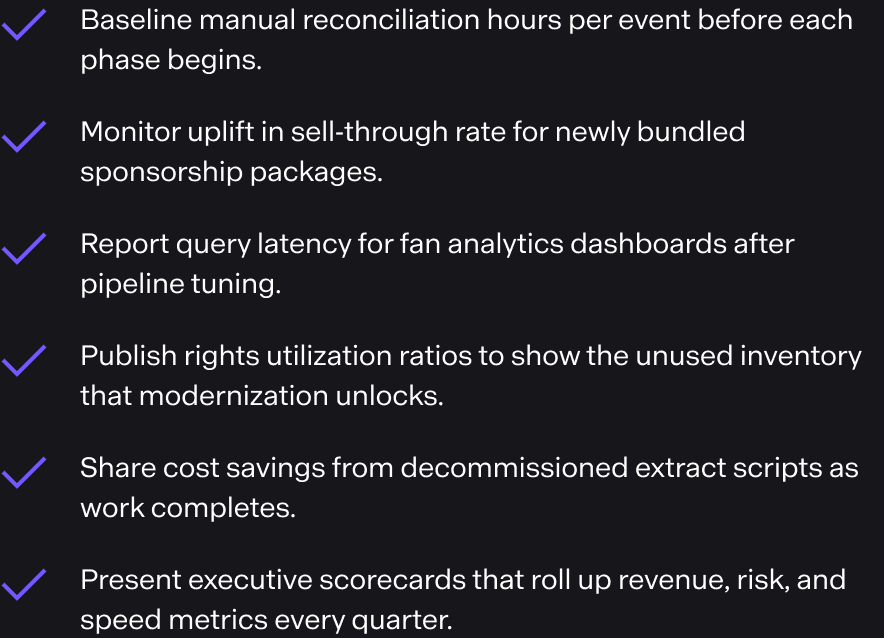
Transparent metrics turn skeptics into champions because improvement is hard to dispute. Finance gains early warnings on cost overruns while product teams see space to innovate. The enterprise shifts from reactive fixes to proactive optimization. Confidence achieved here smooths the pivot from roadmap to ongoing governance.
How Lumenalta®helps sports media CIOs modernize without disruption to live or digital performance
Building trust through visible value reporting naturally leads to asking who can guide the next sprint. Specialized architects work within existing broadcast calendars and vendor contracts while layering modern data practices that never interrupt a match feed. Technical sequencing aligns with revenue milestones, so funding cycles stay healthy. Design reviews happen in real time, letting on‑air staff validate workflow impact before code reaches production.
Lumenalta®applies this approach through a co‑delivery model that ships usable increments every week. Each release carries a clear business metric, from reduced rights leakage to faster highlight turnaround. Security experts weave entitlement logic into data pipelines from the first commit, removing audit anxiety later. CIOs gain a scalable foundation that keeps the lights green for live events while opening pathways to fresh digital revenue.