
Scale with data precision
Tactical playbook for media entertainment CIOs to modernize content and rights systems

Key execution findings
Missed rights windows and spreadsheet stitching drain revenue and trust. Scheduling, metadata, rights, and audience tools live apart, slowing packaging and delaying partner reporting. You do not need a rip and replace. This tactical playbook shows a phased plan that cleans high-priority metadata, connects rights to scheduling, and unifies audience signals. Each step maps to KPIs like content reuse speed, partner reporting time, and first-pass packaging accuracy.
$29B
lost annually in the U.S. from missed rights windows due to disconnected data.*
25 hours
a week spent on manual entry and reconciliation across apps in typical teams.*
$15M
estimated annual drain per enterprise from poor-quality data and rework.*
68.7%
of workflow platforms now cloud deployed, confirming the shift to elastic ops.*
SEP. 18, 2025
3 Min Read
This playbook offers a phased, outcome-first path. Start with the metadata teams touch daily, then surface rights as services, connect scheduling and playout, and put real-time dashboards in front of decision makers. Every phase delivers measurable lift without disrupting live operations, building a foundation for faster packaging, cleaner partner reporting, and auditable rights enforcement.
Why modernization matters now
Missed rights windows and slow packaging are rarely creative problems. They are data problems born of disconnected metadata, scheduling, rights, and audience systems. Spreadsheets and flat-file grids introduce delays that push launches and invite penalties. Investors expect faster returns from digital, and partners expect precise, timely reporting. The cost of waiting rises every week.
How to execute without disruption
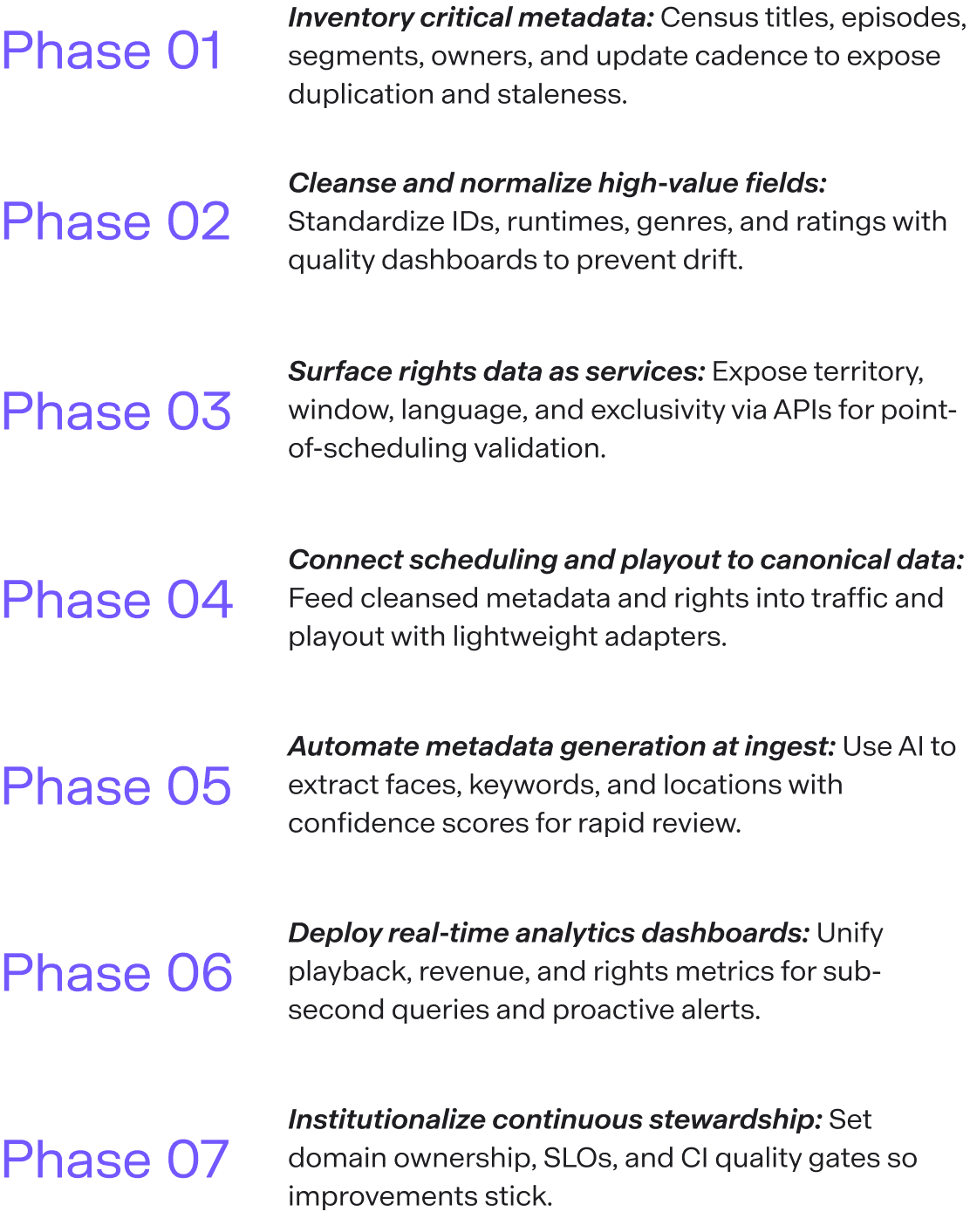
Modernize in phases. Start by inventorying and cleansing the metadata that powers packaging and scheduling. Elevate rights from PDFs to an API so availability is validated before air. Connect scheduling and playout to the same canonical data to eliminate blackouts and late fixes. Automate metadata extraction at ingest and land signals in a warehouse tuned for sub-second queries. Finally, make stewardship continuous with domain owners, SLOs, and CI quality gates. Each phase declares KPIs such as content reuse speed, first-pass packaging accuracy, and partner reporting time.
What results to expect
Expect faster search-to-schedule cycles, fewer QC failures, and sub-day partner reports. Rights incidents fall as policy travels with assets. Teams reclaim hours from manual reconciliation and redirect effort to packaging and monetization. Finance sees cleaner revenue timing and lower rework costs. The outcome is a governed, real-time data layer that protects broadcast continuity while unlocking new revenue models.
*based on external research sources cited within.
Access the playbook CIOs use to modernize media and entertainment data
Need an executive summary? View our roadmap for data modernization in media and entertainment.
FAQs
How can I speed up metadata cleanup in my media workflows without disrupting production?
What are the most important KPIs for data modernization in media entertainment?
How do I manage rights data better across systems and contracts?
What does a scalable data foundation look like for media metadata and analytics?
How can I prove ROI on my data modernization efforts in media operations?





Take the brighter path to software development.