Key Takeaways
Identify where disconnected metadata, rights, and audience data create duplication and delay
CIOs rarely see duplication until it bites them during a last‑minute rights audit. What looks like a single master often hides half a dozen regional edits with mismatched IDs. Audience files live in yet another warehouse, updated on a different cadence. These fracture lines multiply every time a new distribution deal closes.
The cost is no longer abstract. The U.S. Mechanical Licensing Collective holds nearly
$1 billion in unclaimed royalties because songs cannot be matched to correct metadata, a cautionary mirror for film and TV libraries. When video assets lose the same linkage, reconciliation drags, reporting slips, and ad inventory goes unsold.
Disconnected systems also clone errors faster than teams can spot them. A minor title change in the asset library may never reach the schedule feed, triggering version confusion downstream. Rights alerts, if they trigger at all, arrive after a promotion has aired. Every duplicate dataset chips away at trust and slows decision velocity.
Tie modernization priorities to content packaging, monetization, and reporting accuracy
Modernization only sticks when stakeholders see numbers move. Finance cares about incremental revenue, programming cares about windowing agility, and sales cares about inventory certainty. Each group measures progress differently, yet all depend on the same underlying data rows. Linking priorities to revenue moments keeps efforts funded and cross‑team alignment intact.
Video streaming is projected to reach
$416.8 billion in global revenue by 2030 at a 21.5% compound annual rate, turning every asset into a potential annuity. Packaging models that combine first‑run linear, archive streaming, and regional FAST channels succeed when rights, metadata, and audience segments sync automatically. Industry margins continue to tighten, making precision critical. Clean data removes the guesswork from pricing and yield forecasts.
For a CIO, this means ranking data fixes by direct impact on cash flow. The rights lineage that unlocks a single territory can fund the next sprint. Automated reconciliations that bring the monthly close from ten days to two free analysts for higher‑value exploration. When business leaders feel those gains, executive sponsorship never wavers.
Prioritize early wins: sequence modernization to clean critical pipelines first and build momentum
Momentum matters more than perfection during the first six months. Stakeholders judge success by whether tomorrow feels easier than yesterday. A sequence that clears the noisiest pipeline first builds visible relief. That visibility fuels appetite for deeper change.
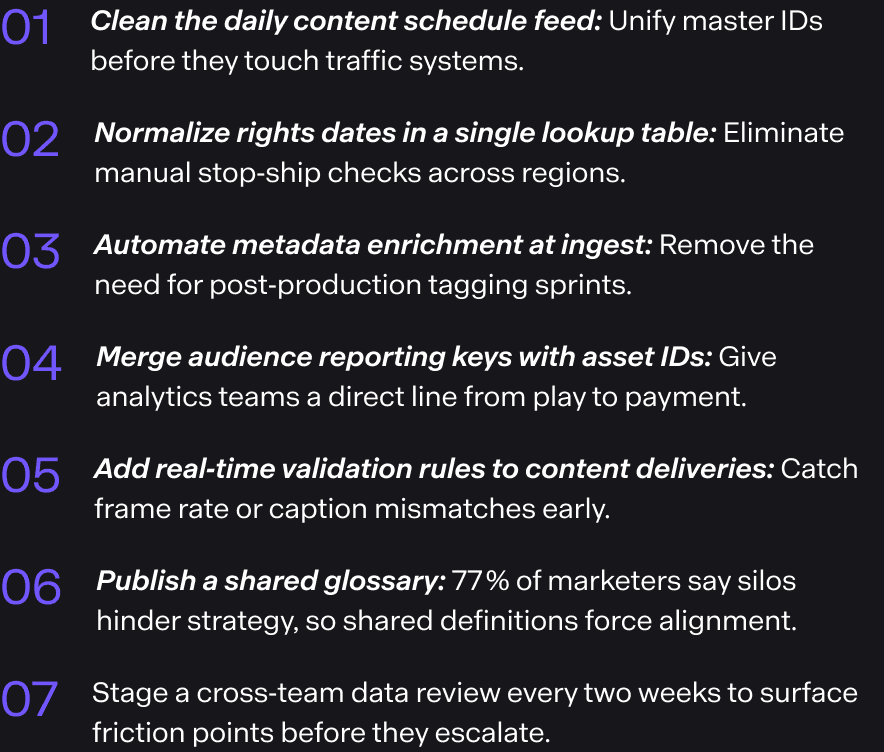
Finishing these tasks inside the first quarter sets an unmistakable tone. Business users see friction drop and update requests shrink. Technical teams gain confidence that future phases will land without fanfare. Most importantly, leadership observes actual cash or time savings, not theoretical models.
Build a foundation that connects content metadata, asset systems, and audience data without disrupting production
Media supply chains never sleep, so foundational refactoring must happen in the background. Instead of a big‑bang cut‑over, create an overlay API layer that translates old schemas into new ones. This approach limits impact on studios, affiliates, and advertising operations. Once traffic proves stable, back‑end stores can migrate piece by piece.
Only
10 % of enterprises reach advanced insight maturity according to Forrester, and the gap often traces to brittle data foundations that collapse under real‑time load. Creating a canonical data contract across asset, rights, and audience domains gives engineering teams a stable surface to iterate on, while existing broadcast systems continue to push content without schedule impact. A message bus that mirrors updates between the overlay and legacy databases ensures zero lost frames during migration.
Foundations matter because they lower future unit costs across every title and campaign. When data models behave predictably, enrichment services and AI add‑ons can be swapped without regression or expensive refactoring. New distribution endpoints, from social short‑form to immersive VR feeds, plug in through configuration, not code rewrites. That predictable posture accelerates every downstream launch and shields budgets from surprise outages.
Need a tactical view? Access our tactical playbook for data modernization in media entertainment.
Apply governance that protects rights enforcement, content usage, and partner compliance
Data without guardrails creates as much risk as opportunity. Content must carry contracts wherever it travels, and audience data has its own escalating rules. Governance should feel like a helpful guide, not a gatekeeper. That starts with precise, practical controls tied to monetization moments.
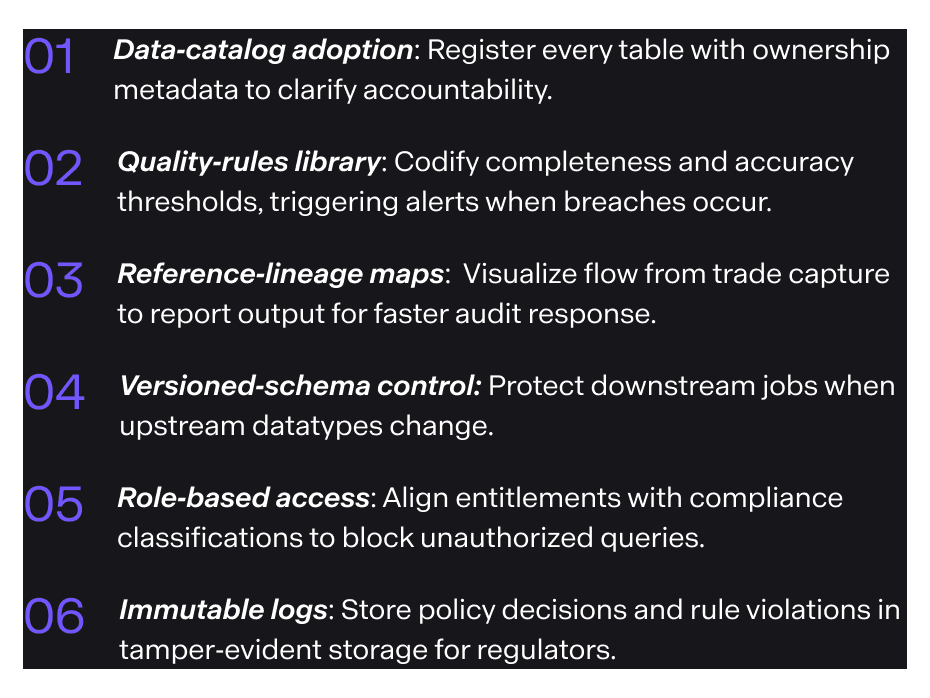
Strong governance builds partner confidence instead of anxiety. Legal teams gain rapid insight into exposure, while sales trusts that packages meet contractual bounds. Marketing benefits too, because consent flags move through the same pipeline as view counts. When every rule is codified, growth never outruns compliance.
Standardize metrics across production, scheduling, monetization, and analytics teams
Metrics are the shared language of cross‑functional delivery. When one title records five different run‑time values, debate replaces action. Harmonizing measures remove hierarchy disputes and focus back on growth. Start with the numbers executives quote in earnings calls and work backward.
Consistent metrics unlock personalization gains. Sixty-seven
percent of viewers prefer ads that match the content they watch, making alignment between audience segments and asset tags essential for yield. A single play counter, duration, and genre code across all systems ensures recommendation engines and ad servers learn from the same truth. With one taxonomy, creative, scheduling, and programmatic teams eliminate conversion tables that previously introduced rounding errors and context drift.
Standardization allows apples‑to‑apples analysis across platforms and partners. Attribution models improve because impression data and rights metadata share keys. The finance team closes books faster, and operations finally speak the same numbers as marketing. Alignment breeds speed.
Track value in reporting speed, packaging precision, and partner trust at every step
Value tracking is the difference between storytelling and scoreboard. Numbers defend investment and silence skepticism. Picking KPIs that executives already watch reduces lift. Reporting must arrive quickly enough to guide the next release window, not just memorialize the last.
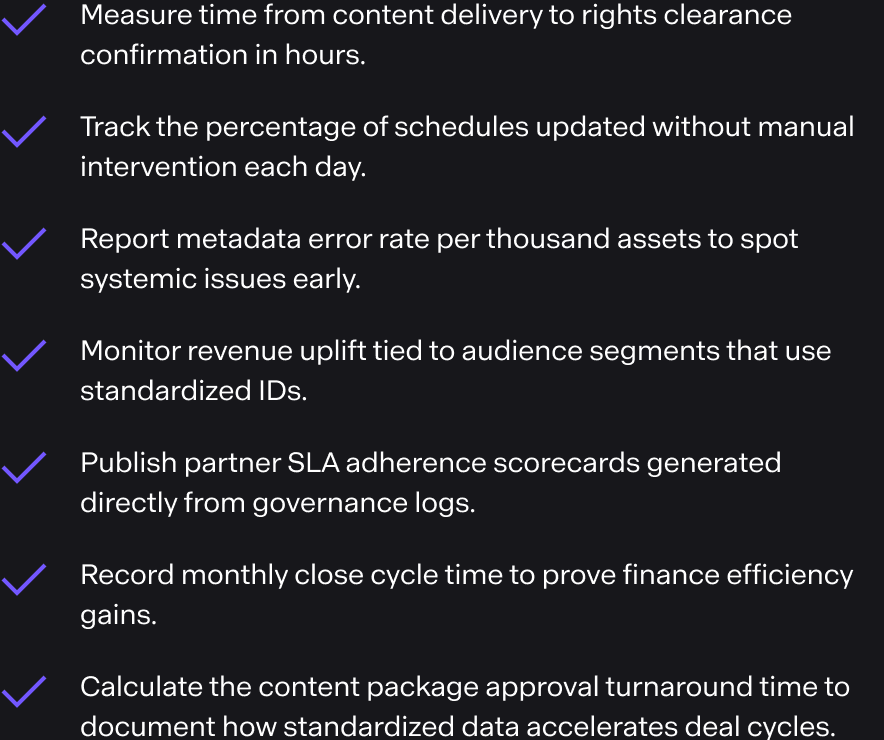
These metrics travel with the roadmap and become its validation engine. Teams see immediate cause‑and‑effect between data fixes and revenue movement. Executives gain a concise dashboard that summarizes risk and upside in equal measure. Trust follows transparency.
How Lumenalta®helps media entertainment CIOs modernize without compromising speed or flexibility
That dashboard‑ready view of value creation feeds directly into how Lumenalta®partners with CIOs. Our engagement starts by codifying the same KPIs inside an iterative modernization backlog, letting stakeholders watch improvements land sprint after sprint. We co‑design a phased architecture overlay that bridges legacy scheduling, rights ledgers, audience data lakes, and ad‑tech logs, so every data source stays visible. Participation from business, legal, and finance leaders in weekly reviews keeps scope aligned while accelerating approvals, eliminating the infamous waiting periods that stall many initiatives.
The model emphasizes measurable business impact over tool selection. Each phase is funded by the cash or efficiency unlocked in the preceding release, reducing capital risk and aligning with board priorities. Security and governance templates come baked in, streamlining audits and clearing the way for faster distribution experiments. When new formats, licensors, or markets emerge, the adaptable data contract absorbs them with minimal re‑work, preserving momentum and sustaining confidence across the executive suite.