


8 reasons enterprise AI pilots fail to reach production
NOV. 24, 2026
6 Min Read
Enterprise AI pilots stall when nobody plans for production on the day the pilot starts.
The pattern is common enough to measure. A widely cited MIT study found that 95% of generative AI pilots delivered no measurable impact on profit and loss. The reasons repeat from company to company, which means you can plan around them before your next pilot starts.
Key Takeaways
- 1. Most AI pilots stall for predictable reasons, and each one is a production criterion that was skipped when the pilot was scoped.
- 2. Pilots that reach production name a business owner, secure approved data access and assign someone to run evaluation from the first week.
- 3. A pilot earns its production budget when it shows a measured business result, a passing test score and a priced path to launch.
8 reasons enterprise AI pilots fail to reach production
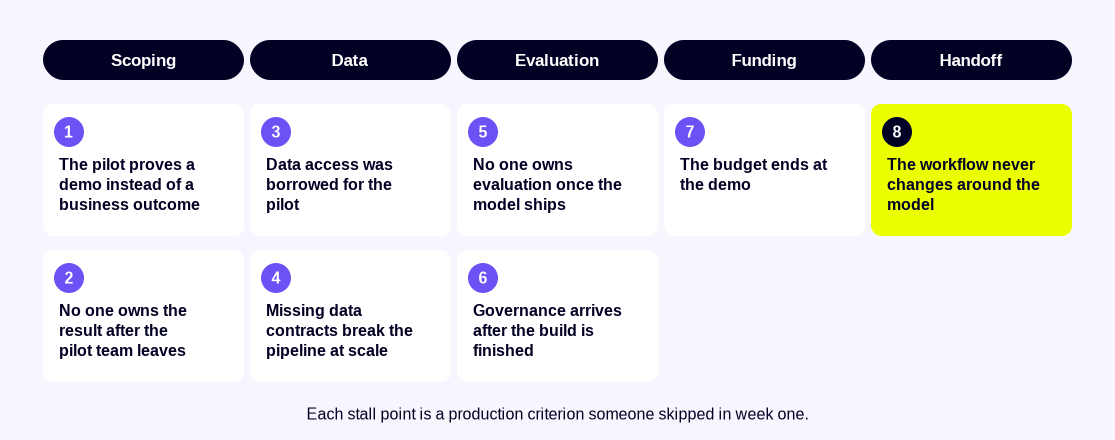
These eight reasons follow the order they tend to appear in a pilot's life, from scoping through data, evaluation, funding and handoff. Each one is a production criterion that someone skipped in week one.
1. The pilot proves a demo instead of a business outcome
A pilot that sets out to show how the model works will succeed and still go nowhere. Executives fund outcomes, such as fewer manual hours, faster claims or higher conversion. If the pilot never measured one, there's no case for production spend. A document summarizer that impresses a steering committee still needs a baseline, such as 40 minutes per file today, to prove it saves time. Define the business measure and its current value before any build starts, and the pilot's result becomes a decision instead of an opinion.
2. No one owns the result after the pilot team leaves
Pilots are often run by an innovation group or a vendor, while production belongs to a business unit. When the pilot ends, the people who built it move on, and the business owner was never named. The model sits in a sandbox with nobody accountable. A pilot needs a business owner from day one who will run the use case afterward. That person signs off on success criteria, attends reviews and carries the budget request forward.
3. Data access was borrowed for the pilot
Many pilots run on an extract someone pulled by hand or on a test workspace with loose permissions. It works for eight weeks. Then security reviews the production plan and finds the data access was never approved for live use. The project goes back to the start. Request the production data path during the pilot, through the same approvals a live system would need. It's slower in week two and much faster in month four.
4. Missing data contracts break the pipeline at scale
A data contract defines what a source delivers, in what format and how often. Pilots skip them because a one-time extract doesn't need one. Production does. When an upstream team renames a column, an uncontracted pipeline fails quietly and the model starts answering with stale or missing data. Context is what turns agent pilots into business value, and contracts are how that context stays reliable once real users depend on it.
"It's slower in week two and much faster in month four."
5. No one owns evaluation once the model ships
Pilots get tested once, at the demo. Production models need testing every week, because data, prompts and model versions change. Without an owner for evaluation, accuracy drifts and nobody notices until a customer complains. Assign one person to keep a fixed test set, run it on every change and report the score. That job is small, and its absence is one of the most common reasons a promising pilot loses executive trust.
6. Governance arrives after the build is finished
Risk, legal and compliance teams often see an AI pilot for the first time when it asks to go live. Their questions about data use, explainability and human review then trigger rework the team never planned. Governance added at the end costs months. Bring those reviewers into scoping, agree on the controls early and build them into the first release. The review at launch then becomes a check of decisions already made.
7. The budget ends at the demo
Pilot budgets usually cover building and showing. They rarely cover integration, monitoring, support and the change work production needs. When the demo succeeds, the team has to start a new funding cycle, and momentum dies while finance reviews it. Price the production path inside the pilot proposal, with a clear gate that releases the next tranche. You'll know the full cost before you commit, and success won't stall waiting for money.
8. The workflow never changes around the model
A model that drafts responses saves nothing if agents still write every reply from scratch. Production value comes from redesigning the work around the tool, including who reviews, which steps disappear and how exceptions get handled. Pilots often bolt AI onto the old process and measure a small gain. Map the new workflow during the pilot and test it with real users, so the business case reflects how work will actually run.
| Reason a pilot stalls | What fixes it in week one |
|---|---|
| 1. The pilot proves a demo instead of a business outcome | Agree on one business measure and record its current value before building. |
| 2. No one owns the result after the pilot team leaves | Name the business owner who will run the use case in production. |
| 3. Data access was borrowed for the pilot | Request the production data path through the approvals a live system needs. |
| 4. Missing data contracts break the pipeline at scale | Write down what each source delivers so upstream changes don't break answers silently. |
| 5. No one owns evaluation once the model ships | Give one person a fixed test set to run on every change. |
| 6. Governance arrives after the build is finished | Invite risk and compliance reviewers into scoping instead of the launch meeting. |
| 7. The budget ends at the demo | Price the full production path and tie the next tranche to a clear gate. |
| 8. The workflow never changes around the model | Redesign the work around the tool and test it with real users. |
What an AI pilot should prove before it scales
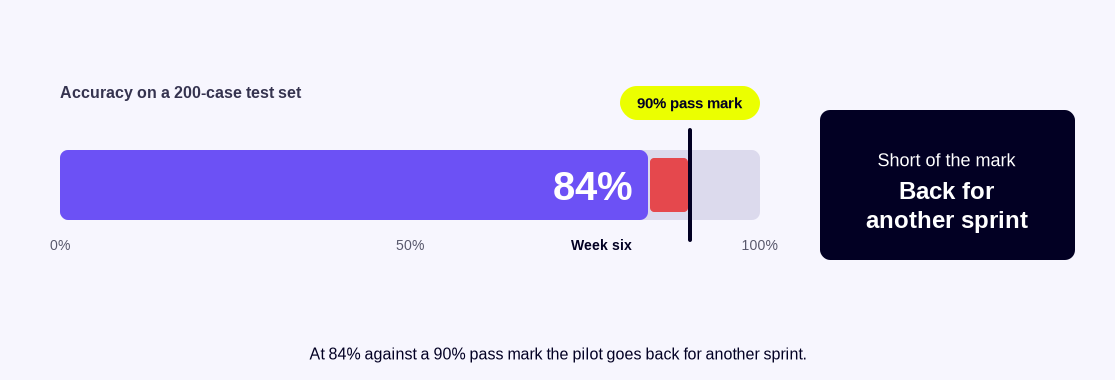
An AI pilot should prove that the use case can run in production with real users and real data. That means a measured business result, an owner, approved data and a passing test score. A pilot that hits those marks has earned its production budget.
Set the bar in numbers. A pilot that needs 90% accuracy on a 200-case test set and lands at 84% in week six goes back for another sprint. It doesn't go to a launch party. That discipline protects your credibility and keeps weak use cases from soaking up the budget strong ones need. Organizations will abandon 60% of AI projects unsupported by AI-ready data, so the data checks below matter as much as the model's score.
- A business measure with a recorded baseline and a target
- A named owner who will run the use case after launch
- Production data access approved by its data owners
- A fixed test set with a pass mark and an evaluation owner
- A priced production path with a funding gate
"A pilot that hits those marks has earned its production budget."
Lumenalta®'s specialist teams rationalize use cases first, then build each pilot against production criteria from week one, so a working use case can scale in releases. That approach is less glamorous than a fast demo. It's also how a pilot becomes a system your business relies on.
Table of contents
- 8 reasons enterprise AI pilots fail to reach production
- 1. The pilot proves a demo instead of a business outcome
- 2. No one owns the result after the pilot team leaves
- 3. Data access was borrowed for the pilot
- 4. Missing data contracts break the pipeline at scale
- 5. No one owns evaluation once the model ships
- 6. Governance arrives after the build is finished
- 7. The budget ends at the demo
- 8. The workflow never changes around the model
- What an AI pilot should prove before it scales
Learn why skipping production criteria in an AI pilot delays ROI and wastes budget.