
AUG. 3, 2026
9 Min Read
Every data platform carries one quiet liability: the thing that still works, so nobody touches it. On Databricks, that thing is the Hive metastore. For years it was the default home for tables, and most organizations that adopted Unity Catalog never fully left it behind. A few pipelines still write to hive_metastore. A handful of notebooks still read from it. Some teams use the two interchangeably without realizing it. It functions, so it stays.
That grace period is closing, and the direction of the platform is no longer ambiguous. The strategic question for every data leader is not whether to migrate. It is whether you finish the migration deliberately, on a schedule you control, or whether the timing gets decided for you.
The deadline is no longer abstract
Databricks has made the target state explicit. Accounts created after December 19, 2025 do not have access to legacy features by default. And starting September 30, 2026, all new workspaces across every account will be provisioned as Unity Catalog-only, without access to the Hive metastore, DBFS root and mounts, no-isolation shared clusters, or Databricks Runtime versions prior to 13.3 LTS.
Read that carefully, because the nuance matters. The hard date applies to new workspaces. Your existing workspaces are not force-flipped overnight, which is precisely why this is a decision and not just a deadline. You still hold the pen. But the platform is converging on Unity Catalog-only as the standard, and every quarter you leave hive_metastore reachable is a quarter you are running against the direction of the product, your security architecture, and your own governance model.
There are only two ways this ends. You disable Hive metastore access on your own terms, after validating that nothing depends on it. Or you leave it open, keep absorbing the risk, and eventually reconcile with a platform that has moved on without you.
Migration alone does not close the door
Here is the trap that catches even mature teams. Even after you migrate to Unity Catalog, Databricks compute clusters still connect to the Hive metastore by default unless you explicitly disable that access. Migrating your tables does not close the door. It leaves it open with a fresh coat of paint.
So a workspace can be “on Unity Catalog” in every architecture diagram while jobs, notebooks, and ad-hoc queries quietly continue to resolve against hive_metastore. The migration is not done when the data lands in Unity Catalog. It is done when the legacy path is closed and provably unused.
Why this is a security decision, not housekeeping
This is where the conversation should move from cleanup to governance. Data in the Hive metastore is not governed by Unity Catalog. It sits outside your fine-grained access controls, outside centralized policy, outside lineage, and outside the unified audit trail. As long as any path to hive_metastore remains open, you are running a lane around your own governance model. For any organization with low tolerance for risk, that is not a technical footnote. It is an ungoverned surface with a credential attached.
This is also why the move is built into Databricks’ own Security Reference Architecture (SRA). The SRA treats Unity Catalog as the foundation for data and AI governance, and it notes that a Unity Catalog-only configuration is required for clusters running without internet access in an isolated network posture. If your target state is private, locked-down compute with no public egress, Unity Catalog-only is not optional. It is a prerequisite. Closing the Hive era cleanly is what unlocks the stricter, recommended architecture in the first place.
Disabling direct Hive access forces every query through Unity Catalog. That means every access is authorized against a single permission model, captured in lineage, and written to the audit trail in system tables. You are not removing a feature. You are removing the exception to your controls.
One caution that experts learn the hard way: disabling legacy access does not neutralize cluster-level credentials such as instance profiles, and No Isolation shared clusters do not respect the disablement setting at all. If you want the guarantee rather than the appearance of one, remove standing credentials from clusters and turn on Enforce user isolation for the workspace. A partial cutover produces a false sense of security, which is more dangerous than no cutover.
The dependencies you cannot see
Most migrations do not stall on the well-known tables. They stall on the dependencies nobody documented. Before you disable anything, assume the surface area is wider than your catalog:
- DBFS mounts and DBFS root. /mnt/... paths are legacy constructs that go away in the same wave as the Hive metastore. Unity Catalog replaces them with external locations and volumes.
- External Hive metastore and AWS Glue configs. Spark configs pointing at an external metastore keep the legacy path alive even when the workspace-local metastore looks empty.
- Init scripts, jobs, and Lakeflow/DLT pipelines that reference hive_metastore explicitly or rely on it as the default catalog.
- Dashboards, notebooks, and SQL warehouses whose default catalog is still hive_metastore.
- Standing credentials (instance profiles, service principals mounted on clusters) that bypass Unity Catalog governance entirely.
If you cannot say with evidence that each of these is clean, you are not ready to disable.
Know before you cut
Confidence here should come from data, not optimism. Three sources give you an evidence-based view of what still touches the Hive metastore:
- System tables. system.access.audit and system.access.table_lineage show who and what is actually reading and writing hive_metastore, over a real time window rather than a guess.
- information_schema and Catalog Explorer to inventory what remains registered in the legacy metastore.
- UCX, the Databricks Labs assessment and migration toolkit. Its assessment workflow profiles Unity Catalog compatibility across tables, storage locations, clusters, jobs, and groups, and produces a report you can run repeatedly until the incompatible entities hit zero. UCX is provided as-is without formal SLAs, but it is the de facto starting point for a defensible migration plan.
For tables that genuinely cannot move yet, Hive metastore federation removes the usual objection. You can federate legacy tables as foreign catalogs so they remain queryable while being governed by Unity Catalog, and you can do that before or after you disable direct workspace access. That takes the risk out of moving decisively.
What “done” looks like before you disable
Before you flip the switch, three conditions should hold. Every table registered in the legacy metastore is migrated to Unity Catalog, or federated so Unity Catalog governs it. Every job runs on Databricks Runtime 13.3 LTS or above, because older runtimes fail once legacy access is off. And you genuinely intend to stop users from reaching legacy tables, which is a policy decision as much as a technical one.
Two levers to close it
Databricks gives you two ways to disable direct Hive access, and the right one depends on your risk appetite and migration maturity.
For a clean, workspace-wide cut, a workspace admin sets Disable legacy access under Workspace admin > Security. Wait about five minutes for the setting to propagate, then restart running clusters. After that, the hive_metastore catalog disappears from Catalog Explorer, SQL against it fails, and fallback is off.
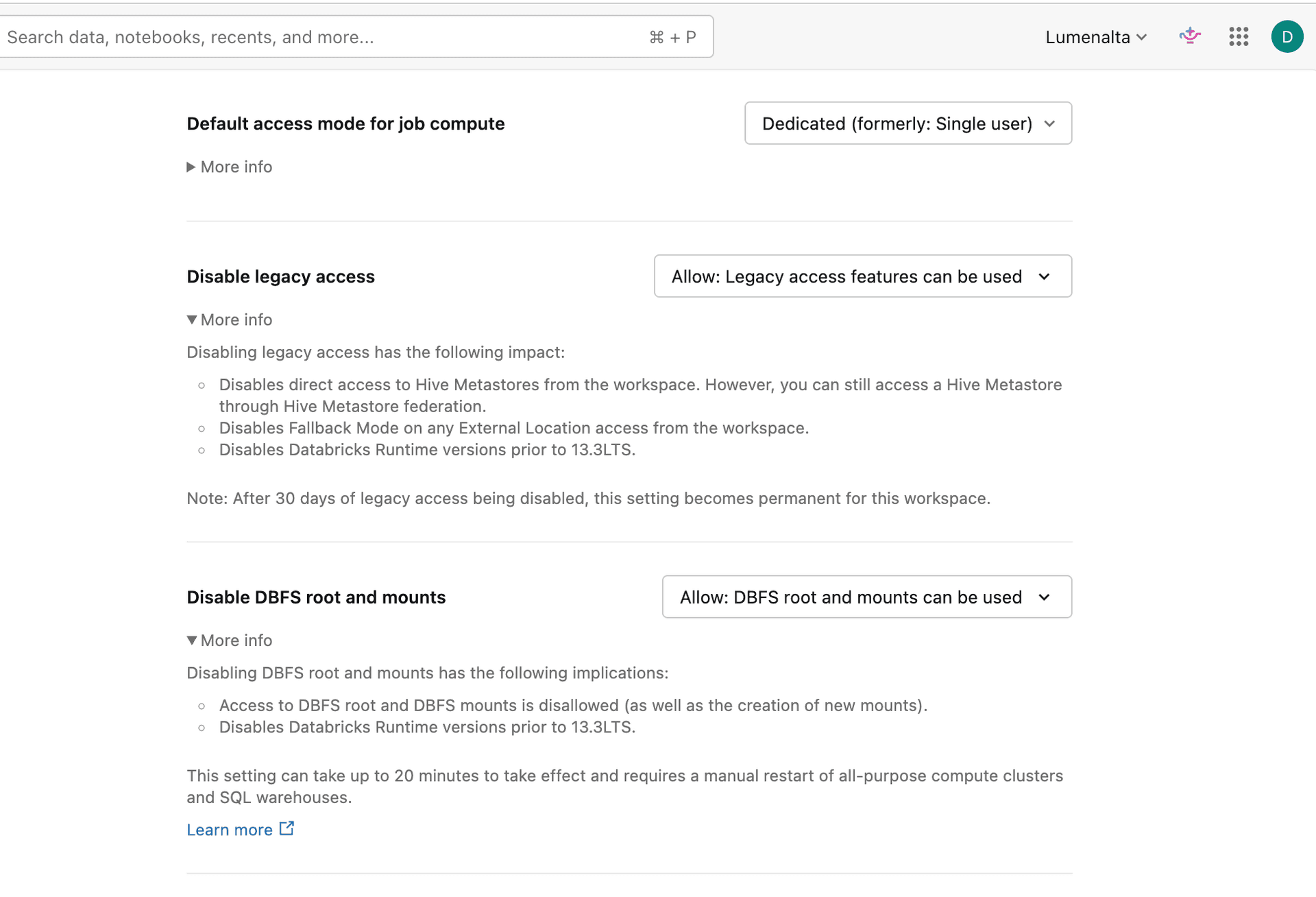
For a gradual approach, disable access cluster by cluster using Spark configuration. On each cluster set:
spark.databricks.unityCatalogOnlyMode True
spark.databricks.sql.initial.catalog.namespace <catalog-name>
Because the cluster can no longer default to hive_metastore, you set an initial Unity Catalog catalog explicitly. This path is ideal mid-migration: you reduce reliance on Hive one workload at a time until you can safely make the workspace-wide change.
At the account level, the Disable legacy features setting (in the account console under Feature enablement) goes further, provisioning new workspaces without the Hive metastore, DBFS root and mounts, no-isolation clusters, or pre-13.3 runtimes in one move. Turning it on early is also the cleanest way to test the September 2026 default behavior before it becomes automatic.
A rollout that de-risks the cutover
The setting is not the hard part. Sequencing is. A rollout that holds up under scrutiny looks like this:
- Assess with UCX and system tables until the legacy dependency list is known and shrinking.
- Migrate or federate every remaining Hive object, and lift all jobs to Databricks Runtime 13.3 LTS or above.
- Disable cluster by cluster in non-production first, then in production, watching for failures against the legacy path.
- Remove standing credentials and enforce user isolation so the guarantee is real.
- Disable workspace-wide, then set the account-level control so new workspaces are born Unity Catalog-only.
Because the workspace-level control is an admin toggle, a surprise dependency in a controlled rollout is recoverable rather than catastrophic. That is exactly why you want to run this deliberately, in non-production first, instead of discovering the dependencies when the platform closes the door for you.
The takeaway for leaders
The Hive metastore has been the “we’ll get to it later” line item on nearly every Databricks roadmap. Later has a date now. The organizations that come out ahead will treat this as a governance milestone they own: complete the migration, prove that nothing still depends on hive_metastore, disable legacy access deliberately, and align to the Security Reference Architecture on the way. The ones that wait will inherit the timing, the outage window, and the incident review.
A closing thought
The hard part is rarely the setting. It is knowing, with evidence, that nothing still depends on the Hive metastore before you disable it, across mounts, init scripts, external metastore configs, jobs, and standing credentials, not just tables. That is where I see most teams underestimate the work, and where a deliberate, well-sequenced cutover pays for itself.
I have walked through this migration enough times to know where it gets stuck and what “done” actually looks like. If you are planning your Unity Catalog-only move, or you are midway and want a second set of eyes on the dependency surface before you flip the switch, I am always glad to compare notes. Reach out, or drop a comment with where you are in the journey. The more we share what is working, the cleaner this transition gets for everyone