


Measuring return on enterprise AI platform investments
NOV. 18, 2026
6 Min Read
Enterprise AI platform returns become provable once every shared platform dollar is assigned to the use cases that consume it.
Most AI business cases are built one use case at a time. A claims triage agent shows hours saved, a forecasting model shows lower inventory, and each team reports a healthy return. The platform underneath them, with its compute, data pipelines, governance tooling and support staff, sits in a separate budget line that nobody claims. When finance adds it back, the returns shrink or vanish. That gap helps explain why MIT's NANDA initiative found that 95% of generative AI pilots were delivering no measurable impact on profit and loss.
The fix isn't a better calculator. It's a measurement model that treats the platform as a shared asset with an owner, a cost pool and a charging rule. Once that model exists, you can compare use cases on equal terms, see when the platform pays for itself and defend the number in a budget review.
Key Takeaways
- 1. AI returns only hold up in a budget review when every use case carries a fair share of the shared platform it runs on.
- 2. Payback should be reported at two levels, per use case and for the platform, because the platform needs several use cases to absorb its fixed cost.
- 3. Finance trusts a measurement model it helped design before results arrive, reported the same way every quarter, including the weak use cases.
Why AI platform ROI claims fall apart under finance review
AI platform ROI claims fall apart because benefits are counted per use case while costs sit in a shared platform budget. Each team reports gross gains against its own direct spend, so the sum of reported returns looks strong while the true return is unknown. Finance spots the mismatch the moment it reconciles the two ledgers.
Consider a bank that runs three agents on one platform. The fraud team counts analyst hours saved, the service team counts shorter call times and the lending team counts faster approvals. None of them carries the cost of the vector store, the evaluation tooling or the platform engineers who keep it running. Those costs show up as a single overhead line, and in the next planning cycle that line looks like waste.
The pressure is real. Gartner predicts over 40% of agentic AI projects will be canceled by the end of 2027, citing escalating costs and unclear business value. Projects that can't show their full cost are the first ones cut.
Shared platform costs belong in every use case calculation
Every use case should carry a fair share of the platform it runs on. That share includes compute, storage, data engineering, governance, monitoring and the people who maintain them. A use case that only looks profitable without its platform share isn't profitable, and leaders should know that before they fund a second phase.
Much of that shared spend buys context, meaning governed data, shared definitions and permissions an agent can read. An agent without that context guesses, however capable the model is. For ROI, that means the catalog, lineage and metric definitions are productive assets. They're the reason the second and third use cases cost less to build than the first, so their cost belongs in the model as an investment that every later use case draws on.
How to allocate platform spend across the use cases it supports
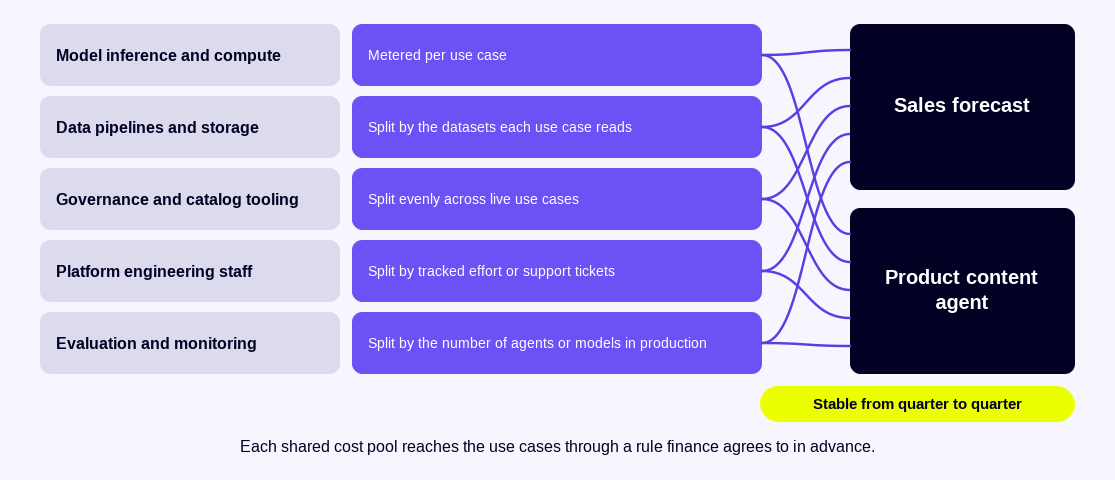
Allocate platform spend with a simple, visible rule that finance agrees to in advance. Usage-based allocation works for compute and storage. Headcount or effort-based allocation works for engineering and governance. The goal is a rule that's stable from quarter to quarter, so teams can plan and the numbers can be audited.
"A use case that only looks profitable without its platform share isn't profitable, and leaders should know that before they fund a second phase."
| Cost pool | How to allocate it | Why it matters for ROI |
|---|---|---|
| Model inference and compute | Metered by tokens, queries or cluster hours per use case | The largest variable cost tracks directly to the team that creates it |
| Data pipelines and storage | Split by the datasets each use case reads | Shared tables spread their cost across every consumer |
| Governance and catalog tooling | Split evenly across live use cases | Every use case benefits from access control and lineage equally |
| Platform engineering staff | Split by tracked effort or support tickets | Heavy users of support pay for the time they consume |
| Evaluation and monitoring | Split by the number of agents or models in production | More production agents mean more ongoing quality checks |
A retailer running a sales forecast and a product content agent would meter inference separately, then split the governance stack evenly between them. Neither team can claim the platform is someone else's problem, and both see the cost of adding a third use case before it's approved.
When Lumenalta®builds this with finance teams, use cases are rationalized first, then more are delivered per person with lean teams. The fixed platform cost spreads across more value, which is where most of the return comes from.
Which metrics a CFO should track for AI agents
A CFO should track a small set of metrics that tie agent activity to money. Cost per completed task and net benefit per use case after platform allocation matter most. Adoption, quality and payback period round out the picture, because an agent nobody uses or trusts produces no return.
- Fully loaded cost per completed task, including the allocated platform share
- Net benefit per use case after platform costs, reported each quarter
- Active usage rate among the people the agent was built for
- Error or escalation rate compared with the manual process it replaced
- Months to payback measured from the first production release
An accounts payable agent shows how these connect. If it processes 40,000 invoices a quarter at a loaded cost below the manual rate, with escalations holding steady, the case is clear. If usage drops after launch, the cost per task climbs even when the technology works.
How long enterprise AI investments take to pay back
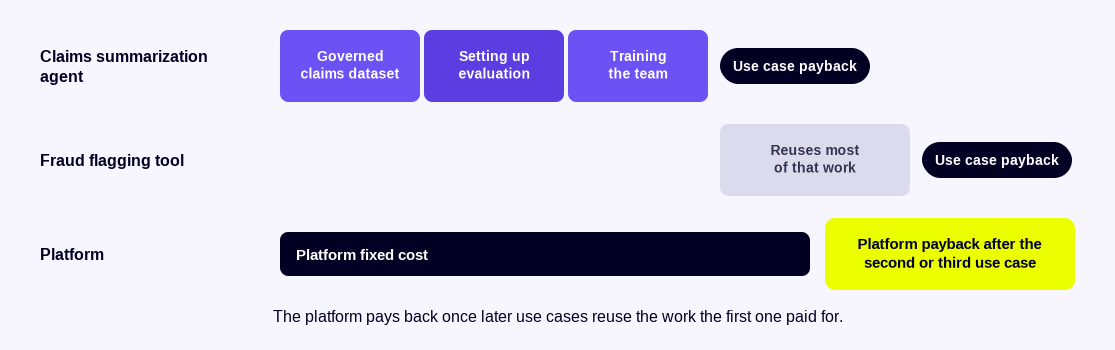
Platform payback is slower than use case payback because the platform's fixed cost needs several use cases to absorb it. A single agent can pay back within a year. The platform beneath it usually pays back only after the second or third use case reuses its data, governance and tooling.
Picture an insurer that builds a claims summarization agent first. The first project carries the full cost of building a governed claims dataset, setting up evaluation and training the team. The second agent, a fraud flagging tool, reuses most of that work and reaches production in a fraction of the time.
That pattern changes how you should set expectations with the board. Report payback at two levels, per use case and for the platform as a whole. Use case payback tells you which projects to scale. Platform payback tells you if the shared investment is working.
The worst outcome is a platform built for ten use cases that only ever carries one. Your measurement model should flag that early, while there's still time to fill the pipeline or scale the platform back.
Common measurement mistakes that inflate agentic AI ROI
The most common mistakes are counting time saved as cash saved, leaving platform costs out of the calculation and measuring before usage stabilizes. Each one inflates the reported return and sets up a painful correction when finance reviews the actuals at year-end.
"The worst outcome is a platform built for ten use cases that only ever carries one."
Time saved only becomes cash when it changes headcount plans, overtime or throughput. A service team that saves 2,000 hours a quarter and then fills them with lower-value work hasn't created a return. Early pilot numbers mislead similarly, because the people testing an agent are usually its most enthusiastic users. Wait until the agent has run with its full user base for at least a quarter, then measure. Agreeing on these rules before launch keeps the debate about the work instead of the arithmetic.
Building a measurement model your finance team will trust
A measurement model earns trust when finance helps design it before the first result comes in. Agree on the cost pools, the allocation rules and the definition of a benefit up front. Then report the same way every quarter, including the use cases that aren't paying off.
That discipline matters more than any single metric. A model that shows one weak use case alongside two strong ones is more believable than one that shows only wins. It also gives you the evidence to retire projects early and move budget to the ones that compound.
Lumenalta® sets up this model with decision traceability and compliance controls embedded in delivery, so every platform dollar can be traced to the use cases it supports. Over time, that record becomes the business case for the next round of investment, built on numbers your CFO has already accepted.
Table of contents
- Why AI platform ROI claims fall apart under finance review
- Shared platform costs belong in every use case calculation
- How to allocate platform spend across the use cases it supports
- Which metrics a CFO should track for AI agents
- How long enterprise AI investments take to pay back
- Common measurement mistakes that inflate agentic AI ROI
- Building a measurement model your finance team will trust
Learn why unallocated AI platform cost delays ROI and wastes budget.