


MCP servers for governed access to enterprise data
NOV. 23, 2026
6 Min Read
A safe MCP server gives an AI agent exactly the data access its user already has, and nothing more.
The Model Context Protocol has become the standard way to connect AI agents to enterprise systems. An MCP server exposes tools and data to an agent through one consistent interface, so teams can plug Claude or another model into a warehouse, a CRM or a ticketing system without writing a custom integration each time. That convenience comes with a catch. A study of 1,899 open-source MCP servers found that 7.2% contained general vulnerabilities and 5.5% showed MCP-specific tool poisoning.
The protocol itself isn't the risk. The risk is what each server is allowed to reach and on whose behalf. That makes the decision to build an MCP server a governance decision before it's an engineering one.
Key Takeaways
- 1. An MCP server decides what an AI agent can see and do, so building one is an access control decision before it's an engineering task.
- 2. Servers that pass the user's identity through and inherit catalog permissions keep one access model instead of two that drift apart.
- 3. A shared gateway, narrow tools, full call logging and human approval for write actions let MCP servers scale across teams safely.
What an MCP server does inside an enterprise
An MCP server sits between an AI agent and a business system. It describes the tools the agent can call, such as running a query or creating a ticket, and it executes those calls against the system behind it. The agent never touches the database directly. Every request passes through the server and its rules.
Consider a sales assistant built on Claude. A rep asks for open opportunities over $500,000 in the western region. The agent calls a search tool on the CRM's MCP server; the server runs the query and returns the results. The rep sees an answer in seconds, and the CRM sees one more API call.
Why every MCP server build is a governance decision
Every MCP server decides what an agent can see and do, which makes it an access control system even when teams don't treat it that way. A server built quickly on a broad service account gives every user of the agent the same wide access. That's a governance choice, made by default.
The exposure grows with each new server. A support team spins one up for the ticketing system, finance builds another for the ledger and marketing connects a third to campaign data. Each one is reasonable on its own. Combined, they create a set of side doors into company data that no central team has reviewed.
The stakes are measurable. 25% of enterprise breaches will be traced back to AI agent abuse by 2028, from both external and malicious internal actors, Gartner predicts. MCP servers with excess permissions are an obvious path for that abuse.
Inheriting catalog permissions beats issuing new ones
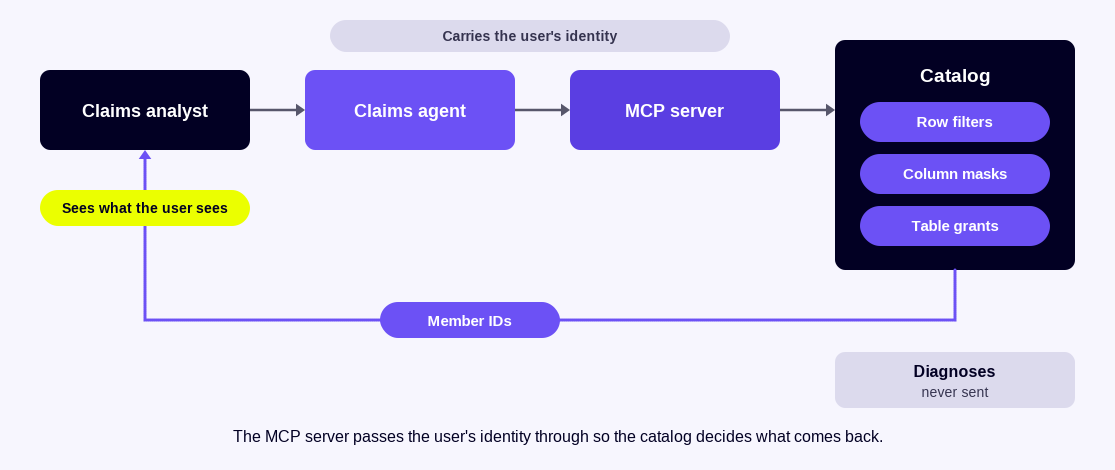
The safest MCP servers pass the user's identity through to the data platform and let the existing catalog decide what's visible. The server doesn't hold its own permission list. It inherits the row filters, column masks and table grants your data team already maintains, so the agent sees exactly what the user would see.
Databricks makes a similar case in its Unity Catalog update from June, arguing that teams should govern what AI agents do as well as what they access. For MCP, that context is the catalog itself. Ownership, tags and access policies defined once in the catalog apply to every request an agent makes, so a masked salary column stays masked when an agent asks, just as it does for a person.
A health insurer shows the payoff. Its claims analysts can see member IDs but not diagnoses. When the claims agent runs through an MCP server that inherits those rules, it can't return a diagnosis even if a prompt asks for one, because the platform never sends it.
Issuing new permissions to the server breaks that chain. Your data team now maintains two access models, and they'll drift apart within a quarter.
How tool design limits what an agent can reach
Narrow tools limit risk better than broad ones. An MCP server that offers a single "run any SQL" tool hands the agent the whole database. A server that offers "get order status by order ID" limits the agent to one table, one filter and one purpose.
"Your data team now maintains two access models, and they'll drift apart within a quarter."
Picture a logistics company whose agent, given a general query tool, joins shipment data to customer contact tables while answering a routine delivery question. Nothing leaks, but the access logs show the agent can reach far more than its job requires. Rebuilding the server with five task-specific tools cuts its reach to what the delivery team actually needs.
Security practices that MCP servers need from day one
MCP servers need the same security baseline as any production API, plus controls for risks specific to agents. Tool descriptions can be poisoned, prompts can be injected through returned data and agents can chain tools in ways nobody planned. These practices belong in the first release. Leaving them for a later hardening phase means the riskiest months run without them.
- Pass the end user's identity through every call instead of using a shared service account
- Pin and review tool descriptions so a changed description can't redirect the agent
- Require human approval for tools that write, delete or send data outside the company
- Log every tool call with the user, the agent, the inputs and the rows returned
- Rate limit each tool so a looping agent can't pull an entire table
The approval step matters most for write actions. An agent that drafts a refund is useful. One that issues refunds without review is a liability, and the MCP server is the right place to draw that line.
An MCP server architecture that scales across teams
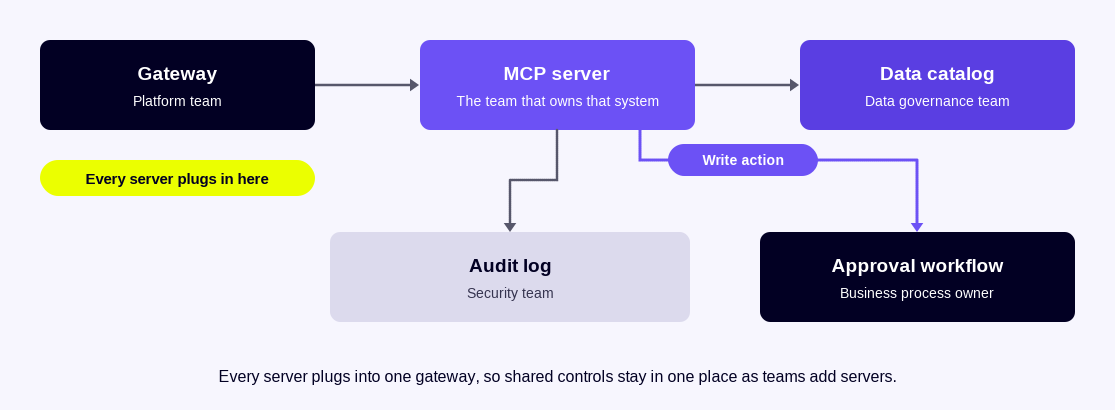
A scalable MCP architecture puts servers behind a shared gateway that handles identity, logging and policy in one place. Teams still build the servers for their own systems, but they plug into common controls instead of reinventing them. That keeps the number of servers growing without growing the number of security models.
| Layer | What it handles | Who owns it |
|---|---|---|
| Gateway | Authenticates users, routes calls and enforces shared policies | Platform team |
| MCP servers | Expose narrow, task-specific tools for one business system | The team that owns that system |
| Data catalog | Holds row filters, column masks and table grants for every dataset | Data governance team |
| Audit log | Records each call with user, agent, tool and result for review | Security team |
| Approval workflow | Routes write and external-send actions to a person before they run | Business process owner |
Lumenalta®designs MCP servers on this pattern for Claude and other models, with servers that inherit catalog permissions instead of issuing new ones. Specialist teams and agents build the gateway and the first servers on one plan, so the controls exist before the second team asks to connect.
Choosing who owns and approves MCP servers
Every MCP server needs a named owner, a documented scope and an approval path before it reaches production. The owner is accountable for which tools it exposes. The data governance team confirms it inherits catalog permissions. Security reviews the logs and the write actions.
"An agent that drafts a refund is useful. One that issues refunds without review is a liability, and the MCP server is the right place to draw that line."
That process sounds slow, but it gets faster with each server, because the gateway and catalog are already in place. The fifth server goes through the same checklist as the first and usually passes in days.
Lumenalta® builds MCP servers with governance built in, embedding decision traceability and compliance controls in delivery so every tool call can be tied to a person and a policy. Teams that hold that discipline from the first server end up with agents they can expand safely, one governed connection at a time.
Table of contents
- What an MCP server does inside an enterprise
- Why every MCP server build is a governance decision
- Inheriting catalog permissions beats issuing new ones
- How tool design limits what an agent can reach
- Security practices that MCP servers need from day one
- An MCP server architecture that scales across teams
- Choosing who owns and approves MCP servers
See how governed MCP servers improves AI accuracy and controls spend.