


Master data governance as the first fix for AI accuracy
NOV. 2, 2026
6 Min Read
Fixing master data is the cheapest accuracy gain you can buy for enterprise AI.
When customer, product and supplier records disagree across systems, every model and agent built on them inherits the conflict. A churn model scores the same customer twice under two IDs. A procurement agent pays a supplier at an address finance retired last year. None of these failures show up as errors on a dashboard. They show up as confident answers that don't reconcile with the systems your finance and operations teams already trust.
The gap is common. 63% of organizations either lack or are unsure they have the right data management practices for AI, based on a Gartner survey of 1,203 data management leaders. Model tuning can't repair a record that's wrong at the source, and every new use case built on that record repeats the error. Governing master data first gives every downstream AI investment a reliable starting point, and it costs far less than another round of model work.
Key Takeaways
- 1. Conflicting customer, product and supplier records cap AI accuracy, and no model upgrade raises an answer above the quality of the record it reads.
- 2. Start master data governance with the one domain your highest-value AI use case depends on, and finish it before moving to the next.
- 3. Business owners define what a correct record means, while platform teams enforce it with matching, survivorship, lineage and access controls.
Why master data quality sets the ceiling on AI accuracy
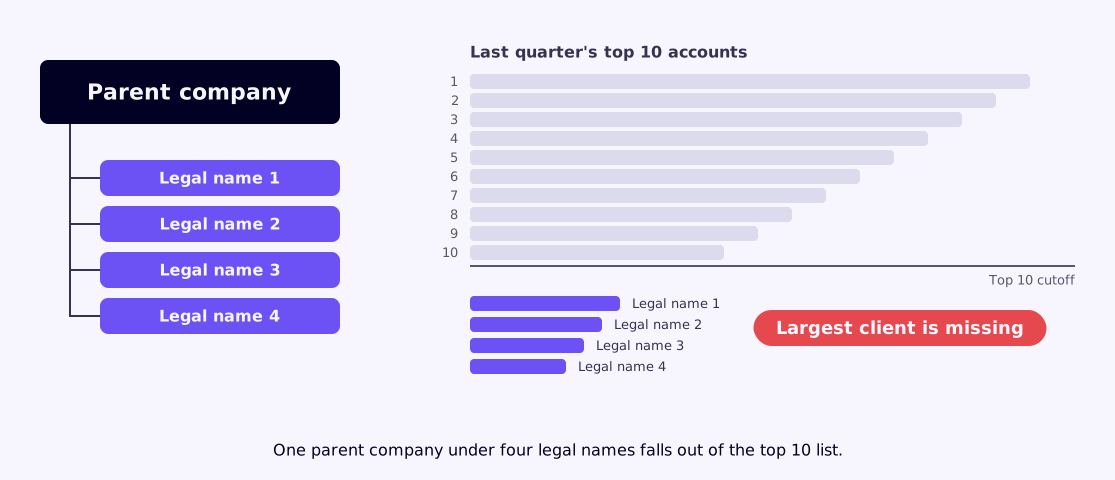
Master data quality sets the ceiling on AI accuracy because models and agents can only be as correct as the records they reason over. A retrieval system that finds three versions of one customer will pick one or blend them. No prompt, fine-tune or larger model raises accuracy above that ceiling.
Consider a revenue assistant asked for last quarter's top 10 accounts. If a parent company appears under four legal names, its revenue splits across four rows and the account drops out of the list. The answer is fluent, cited and wrong, and nobody notices until a sales leader asks why their largest client is missing.
The investment pattern backs this up. Organizations with successful AI initiatives invest up to four times more in data and analytics foundations, as a share of revenue, than those with poor AI outcomes, according to Gartner research published in April 2026. Master data is the part of that foundation every use case touches, so it's where the spending returns first.
What master data governance covers in an enterprise
Master data governance is the set of owners, rules and controls that decide what a customer, product, supplier or location record must contain and which version is correct. It covers definitions, matching, survivorship and change approval. Its job is to make one trusted record available to every system and model that needs it.
"The answer is fluent, cited and wrong, and nobody notices until a sales leader asks why their largest client is missing."
A working program usually covers five areas.
- Shared definitions for each domain, such as what counts as an active customer
- Match and merge rules that decide when two records describe the same entity
- Survivorship rules that pick the winning value for each attribute
- Named stewards who approve changes and resolve disputes
- Quality checks that run on every load and alert the owning team
Definitions are where most programs slip. A distributor whose finance team counts an active customer as one with an order in 12 months will report a different number from sales, which uses 24 months. Until one definition is written down and enforced, any AI that answers questions about active customers will contradict at least one team.
How duplicate records spread errors through enterprise AI systems
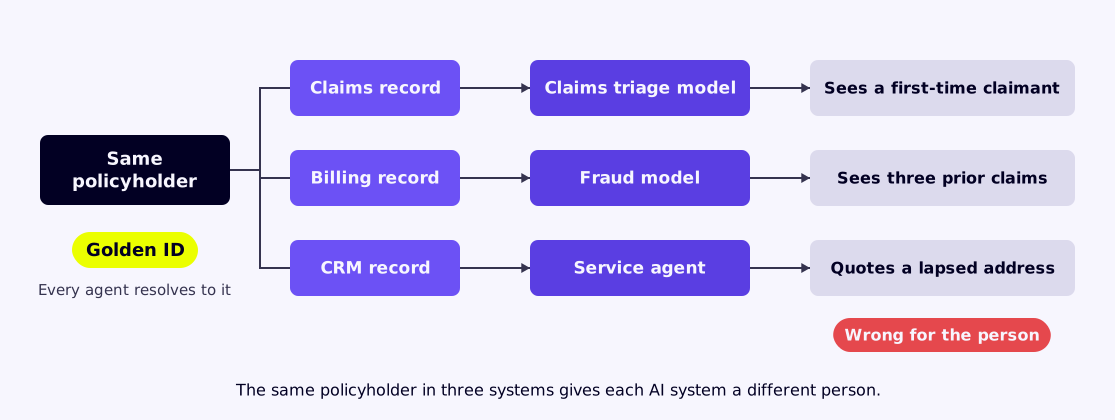
Duplicate records spread errors because each copy carries part of the truth. Models trained on them learn split behavior, and agents acting on them update one copy while reading another. The error compounds with every system that syncs from the wrong record, so a single duplicate can surface in dozens of AI answers.
Picture an insurer holding the same policyholder in its claims, billing and CRM systems under slightly different names. A claims triage model sees a first-time claimant. A fraud model sees a customer with three prior claims. A service agent drafting a reply reads the CRM record and quotes a lapsed address. Each output is correct for its own record and wrong for the person.
Governed business definitions are the context agents need to act correctly. For duplicate records, that context is a golden ID every agent resolves to before it reads or writes anything.
Order matters here. Resolve identity first, then let models and agents read from the resolved record. Deduplicating after an agent has already written to three systems costs far more than matching before it ever sees them.
Where to start when master data spans many systems
Start with the one domain your highest-value AI use case depends on, and govern it end to end before touching the next. For most enterprises, that's customer data for revenue use cases or supplier data for procurement and finance. Picking by use case keeps the scope small enough to finish.
A manufacturer planning an AI assistant for purchase order exceptions doesn't need a product hierarchy cleanup first. It needs one supplier record with a verified tax ID, remit-to address and payment terms, matched across ERP and procurement. That's a few weeks of matching and stewardship work, and it shows up quickly as fewer exceptions the assistant gets wrong. Trying to govern every domain at once is the usual reason programs stall after the platform goes live, because no single team sees a result for months.
Who should own master data in a large enterprise?
The business should own the meaning of master data, and technology should own the controls that enforce it. A named data owner in finance, sales or procurement decides what a correct record looks like. Platform teams turn that decision into match rules, validation and access policies that run without manual effort.
Supplier data shows how the split works. Procurement decides when a supplier is active, which entity is the parent and who can approve a bank detail change. Engineering builds the workflow that blocks an unapproved change and logs who made it. When one side owns both jobs, you get definitions nobody enforces or controls nobody understands.
Lumenalta®'s specialist teams build this split into the data platform itself, with decision traceability and compliance controls embedded in delivery. Stewards see the records waiting on them, and every change carries an owner and a reason that an auditor or an AI evaluation can trace.
How to evaluate master data management tools for large enterprises
Evaluate master data management tools on how well they fit the platform you already run and how they expose governed records to AI. Matching quality, stewardship workflow and lineage matter more than feature count. A tool that keeps the golden record outside your data platform adds one more copy to reconcile.
"When one side owns both jobs, you get definitions nobody enforces or controls nobody understands."
A bank comparing two vendors might find both match customers with similar accuracy. The deciding factor is often where the golden record and its permissions live, either in the same catalog your models query or in a separate hub that needs nightly syncs. These criteria separate a tool that raises AI accuracy from one that adds another silo.
| Criterion | What good looks like for AI accuracy |
|---|---|
| Matching and merge quality | Rule-based and probabilistic matching you can tune per domain and explain to a steward |
| Survivorship control | Attribute-level rules that pick the trusted value and record why it won |
| Platform fit | Golden records stored in the same governed platform your models and agents already query |
| Stewardship workflow | Queues that route disputed matches to the named business owner with a clear deadline |
| Lineage and audit | Every merge, split and edit traceable to a source system, a rule and a person |
| Access policies | Permissions that travel with the record so an agent sees only what its user can see |
Platform fit and access policies usually decide the outcome, because they determine whether agents read the golden record directly or a synced copy that drifts. Score each vendor on all six rows using your own records in a proof of concept rather than a demo dataset, and weight the rows your highest-value AI use case depends on.
Why governed master data pays off before any model upgrade
Governed master data pays off first because it raises the accuracy of every model and agent at once, while a model upgrade improves one system at a time. It also compounds. Each new AI use case starts from records that already reconcile, so teams spend their time on the use case instead of on cleanup.
The opposite pattern is familiar to most data leaders. A team swaps in a newer model, accuracy moves a few points, and finance raises the same reconciliation complaints a month later. The model was never the constraint.
Disciplined master data work looks unglamorous. It's definitions agreed in a room, match rules tuned against actual duplicates and stewards who clear their queues every week. Kept up for a year, it's what lets an AI answer about revenue, inventory or supplier spend match the number in the general ledger.
That's the standard Lumenalta® holds when it pairs master data governance with the data platform build. AI outputs have to reconcile with the systems finance and operations already trust, or people won't use them, however good the model is.
Table of contents
- Why master data quality sets the ceiling on AI accuracy
- What master data governance covers in an enterprise
- How duplicate records spread errors through enterprise AI systems
- Where to start when master data spans many systems
- Who should own master data in a large enterprise?
- How to evaluate master data management tools for large enterprises
- Why governed master data pays off before any model upgrade
See how master data governance lowers cost and improves data agility.