


Delta Lake vs. Iceberg for open lakehouse table formats
NOV. 16, 2026
6 Min Read
The right open table format is the one that fits the engines you run and the governance you need, and on Databricks you can use both.
Debates about Delta Lake and Apache Iceberg tend to focus on features and benchmarks. Those details matter less every year, because both formats now share the same core ideas, and the largest platforms read and write both. The decision that actually shapes your data platform is about interoperability, which engines touch the data and how access is governed across them. Databricks paid more than $1 billion for Tabular, the company founded by Iceberg's creators, to bring the two formats closer.
That move tells you where the market is going. Format lock-in is fading, and the teams that win will pick a format based on their own constraints instead of the loudest argument online.
Key Takeaways
- 1. Delta Lake and Apache Iceberg share the same core capabilities, so the engines that read and write your tables should decide the format.
- 2. Databricks supports both, with UniForm exposing Delta tables to Iceberg readers and Unity Catalog managing native Iceberg tables for outside engines.
- 3. Governance lives in the catalog, so permissions, lineage and definitions must follow a table into every engine that reads it.
What separates Delta Lake from Apache Iceberg in practice
The main difference between Delta Lake and Apache Iceberg is where each grew up. Delta Lake was built by Databricks and is tightly tied to Spark and the Databricks runtime. Iceberg came out of Netflix with a design focused on engine neutrality. Both offer ACID transactions, schema evolution and time travel on files in cloud storage.
Their metadata models differ. Delta Lake keeps a transaction log of JSON commits with periodic checkpoints. Iceberg uses a tree of metadata files and manifests that any engine can read through a catalog. In practice, that means Iceberg has broader native support across query engines such as Trino, Flink and Snowflake. Delta Lake has deeper optimization inside Databricks, where features like liquid clustering and predictive optimization work out of the box.
How Databricks supports Apache Iceberg alongside Delta Lake
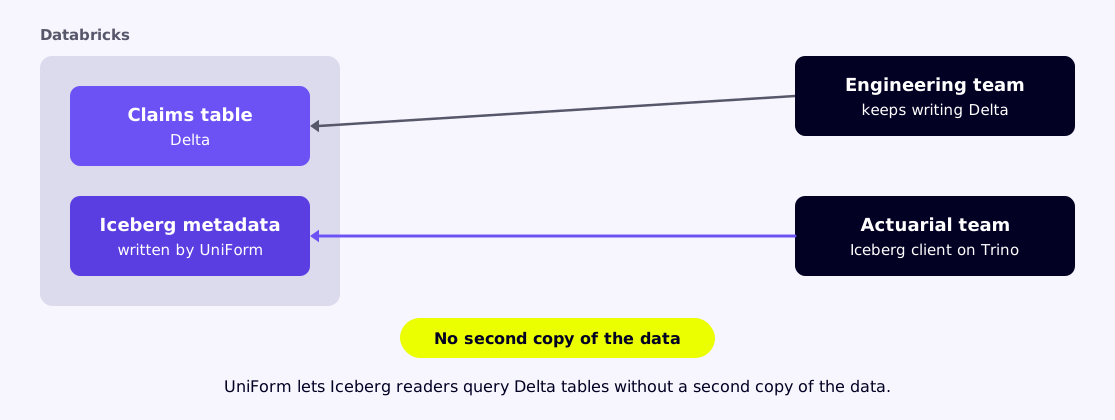
Databricks supports Iceberg in two ways. UniForm writes Iceberg metadata alongside Delta tables, so Iceberg readers can query Delta data without a copy. Unity Catalog also manages native Iceberg tables and exposes them to outside engines through the Iceberg REST catalog interface.
Picture an insurer that runs its core pipelines on Databricks but has an actuarial team using Trino. With UniForm switched on, the actuaries query the same claims tables through an Iceberg client, while the engineering team keeps Delta's optimization features. Nobody maintains a second copy of the data, and nobody argues about which format won.
The tradeoff is that UniForm is a compatibility layer, so a few Delta features don't translate to Iceberg readers. Check the features your outside engines need before you rely on it for a critical workload. If a Trino report depends on a feature UniForm can't express, you'll find out in production unless you test it first.
Why the engines you already run should decide the format
Your existing engines are the strongest signal for the format choice. If most reads and writes happen on Databricks, Delta Lake gives you the most optimization with the least effort. If several engines need to write to the same tables, native Iceberg with a shared catalog avoids sync problems.
"Nobody maintains a second copy of the data, and nobody argues about which format won."
A retailer that ingests with Flink, transforms in Spark and serves dashboards from a separate warehouse has three writers and readers. That profile favors Iceberg as the shared format. A bank that runs nearly everything on Databricks, with a few downstream readers, gets more from Delta with UniForm enabled for those readers.
Lakehouse is now the primary platform for storing and processing data for 26.8% of data professionals surveyed in the 2026 State of Data Engineering survey. As that share grows, more estates will mix engines, which makes the read and write map more useful than any feature list.
Governance matters more than the table format you pick
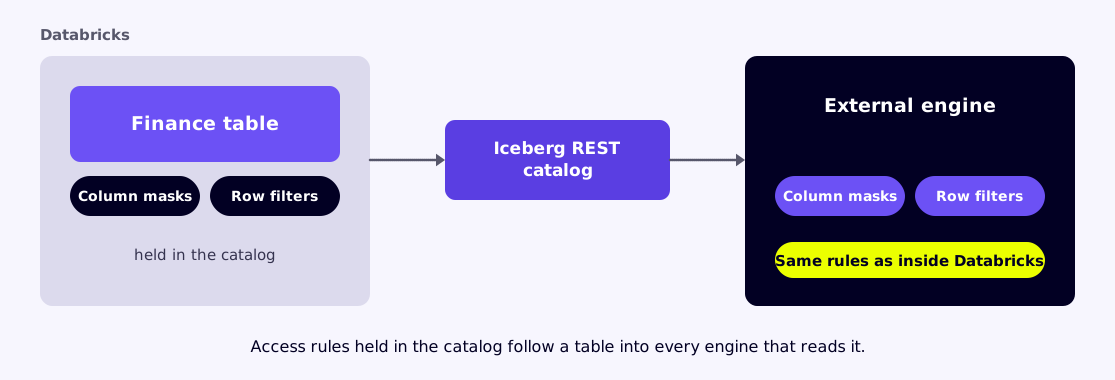
Table formats store data, but they don't decide who can see it. Governance lives in the catalog, which holds permissions, lineage and business definitions. Two teams using different formats under one catalog are better governed than two teams using the same format under separate catalogs with separate rules.
Databricks argues that governed business definitions are the context layer AI agents need. For table formats, that means the catalog should carry ownership, tags and metric definitions that follow a table no matter which engine reads it. A finance table exposed to an external engine through the Iceberg REST catalog should carry the same column masks and row filters it has inside Databricks, or the open format becomes an open door.
How the two formats compare on performance at scale
Performance differences between the formats are smaller than benchmarks suggest and depend mostly on the engine and table layout. Delta Lake tends to perform best on Databricks, where the runtime is tuned for it. Iceberg tends to perform well across many engines, though tuning varies by engine.
| Decision factor | Delta Lake | Apache Iceberg |
|---|---|---|
| Primary engine | Strongest when most work runs on Databricks and Spark | Strongest when several engines read and write the same tables |
| Metadata model | Transaction log of commits with periodic checkpoints | Tree of metadata files and manifests read through a catalog |
| Interoperability | Reaches Iceberg readers through UniForm on Databricks | Native support across Trino, Flink, Snowflake and Spark |
| Performance tuning | Automated layout and clustering features inside Databricks | Tuning depends on each engine's own maintenance tools |
| Governance | Managed in Unity Catalog with fine-grained access control | Managed in Unity Catalog or another REST-compatible catalog |
Small files and poor partitioning hurt both formats far more than the choice between them. A streaming table that writes thousands of tiny files will slow down on either format until compaction runs. That's why layout and maintenance jobs deserve as much design attention as the format itself, since they decide most of the query cost your teams see each month.
When an enterprise should choose Iceberg as its primary format
Iceberg makes sense as the primary format when several engines write to the same tables, when you expect to change processing platforms or when a partner requires it. It's also a sound pick for data shared across business units that run different stacks.
"Small files and poor partitioning hurt both formats far more than the choice between them."
Use these signals to test the case for Iceberg.
- Two or more engines need to write to the same production tables
- Data products are shared with partners who standardize on Iceberg
- Business units run different processing platforms against shared data
- Your catalog strategy already relies on the Iceberg REST interface
- Exit flexibility from any single engine is a stated architecture goal
If none of these apply and most work runs on Databricks, Delta Lake with UniForm usually gives you more for less effort. As a certified Databricks Delivery Partner (DPP), Lumenalta®maps those engines and writers before recommending either format, so the choice rests on how your data is actually used.
Making a table format decision that holds up over time
A table format decision holds up when it's tied to your engine map and governance model, written down and revisited when those change. Treat it as an architecture decision with clear criteria. A one-time bet on which project wins the next round of releases won't survive your first platform change.
Lumenalta® approaches the choice with governance built in, embedding decision traceability and compliance controls in delivery so each table's format and access rules are recorded in the catalog. When a new engine arrives, the team can see what it will read, under which permissions, and add support without a migration.
Table of contents
- What separates Delta Lake from Apache Iceberg in practice
- How Databricks supports Apache Iceberg alongside Delta Lake
- Why the engines you already run should decide the format
- Governance matters more than the table format you pick
- How the two formats compare on performance at scale
- When an enterprise should choose Iceberg as its primary format
- Making a table format decision that holds up over time
See how an open lakehouse table format lowers cost and improves data agility.