


Agentic RAG and how it differs from standard retrieval
NOV. 11, 2026
6 Min Read
Agentic RAG gets more enterprise questions right because it plans its searches, retrieves again when the first pass falls short and checks its sources before it answers.
Standard retrieval-augmented generation runs one search, passes the top results to a model and trusts the answer is in them. That works for a policy lookup. It breaks when a question spans three systems, needs a date filter or depends on a definition held in another team's documents. Models still fill those gaps with confident guesses, and hallucination rates on one knowledge benchmark ranged from 22% to 94% across the models in Stanford's 2026 AI Index.
Agentic retrieval closes much of that gap with a loop that reasons about what it found. The loop only pays off when the content underneath is governed, current and permissioned. That's why the real work sits in your data as much as in the agent.
Key Takeaways
- 1. Agentic RAG puts an agent in charge of retrieval, so it plans queries, searches again when results fall short and grades evidence before the model answers.
- 2. Route only multi-part, cross-system or high-stakes questions to the agent and keep single-fact lookups on standard retrieval to control cost and latency.
- 3. Accuracy gains appear first on governed content with owners, dates and permissions, so fix the content behind a question type before adding the agent.
What agentic RAG means for enterprise search and answers
Agentic RAG is retrieval-augmented generation in which an AI agent controls the retrieval step. The agent breaks a question into parts, picks which sources to query and judges the results. When they don't answer the question, it searches again. The model still writes the answer, but only after the agent has assembled evidence it trusts.
Picture a claims analyst asking why reimbursement times rose in the Midwest last quarter. A standard pipeline pulls five passages that mention reimbursement and the Midwest. An agentic pipeline splits the question first. It queries the claims warehouse for the time series, pulls the regional policy change from the document store and confirms both cover the same quarter.
That shift matters because enterprise questions rarely live in one place. The planning step turns retrieval from a single lookup into a short investigation. You'll see the difference in answers that cite the right table and the right memo instead of the closest-sounding paragraph.
How standard retrieval answers a single question
Standard retrieval answers a question in one pass. It converts the query into an embedding, finds the nearest chunks in a vector index, places them in the prompt and asks the model to respond. There's no step that asks if those chunks were the right ones, so retrieval quality sets the ceiling on answer quality.
A support team using this pattern for product documentation gets fast answers to questions like how to reset a device or which plan includes single sign-on. Each question maps to one passage, and the nearest chunk usually holds it. Latency stays low and cost per query stays small.
The same pipeline fails quietly on a question like which customers on the legacy plan filed tickets after the March release. Nearest-neighbor search returns passages about the legacy plan and passages about the March release. The model stitches them into an answer that sounds right and isn't, and nothing in the pipeline notices.
How agentic RAG differs from traditional RAG in practice
The main difference between agentic RAG and traditional RAG is who controls retrieval. Traditional RAG runs a fixed search and hands the results to the model. Agentic RAG gives an agent the job of planning queries, choosing tools and grading evidence. The agent also decides when it has enough to answer.
| Aspect | Standard retrieval | Agentic retrieval |
|---|---|---|
| How queries are formed | The user's question is embedded once and searched as written | The agent rewrites the question and splits it into targeted queries |
| Which sources are used | One vector index chosen when the system was designed | Several tools, such as vector search, a SQL warehouse and an API, picked per question |
| How evidence is checked | Results go straight into the prompt without review | The agent grades results and searches again when they fall short |
| Cost and speed | One retrieval call keeps answers fast and inexpensive | Several calls raise cost and add seconds to each answer |
| Questions it suits best | Single-fact lookups that one passage can answer | Multi-part questions that span systems or time periods |
The tradeoff shows up in the last two rows. You're buying accuracy on hard questions with extra latency and model calls. That's a good trade for an analyst reconciling quarterly figures and a poor one for a chatbot handling password resets.
The components inside an agentic RAG architecture
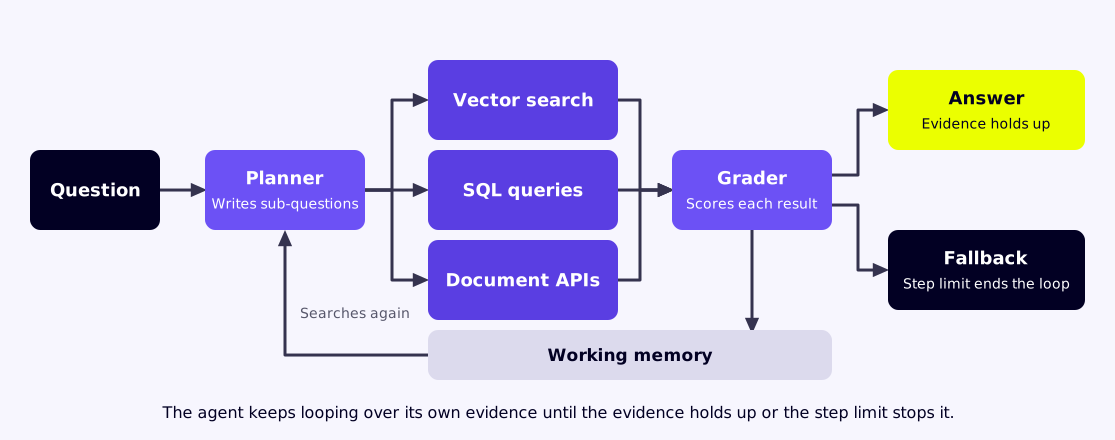
An agentic RAG architecture adds a reasoning layer on top of the familiar retrieval stack. The agent sits between the user and a set of retrieval tools. It works in a loop of planning, searching, grading and answering until the evidence holds up or a step limit stops it.
"The grader and the step limit are where teams cut corners first, and they're the parts that keep the loop honest."
Most production designs include five parts.
- A planner that breaks the question into sub-questions and orders them
- Retrieval tools such as vector search, SQL queries and document APIs, each with its own permissions
- A grader that scores each result for relevance and freshness before it reaches the prompt
- Working memory that holds what the agent already found so it doesn't repeat searches
- A step limit with a fallback that ends the loop and states what the agent couldn't confirm
The grader and the step limit are where teams cut corners first, and they're the parts that keep the loop honest. Without a grader, the agent repeats standard retrieval with extra steps. Without a step limit, a vague question can trigger dozens of tool calls and a bill nobody planned for.
Why self-checking retrieval reduces hallucinated answers in production
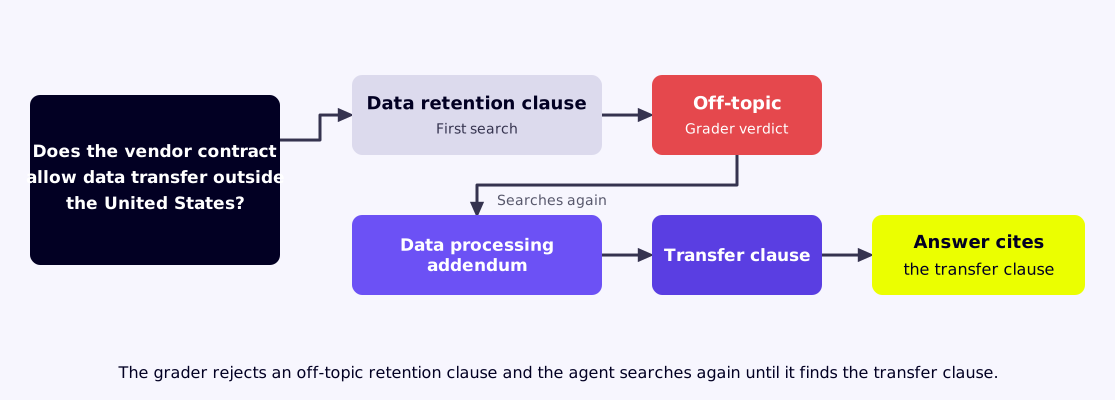
Agentic RAG reduces hallucinations because it checks evidence before the model writes. When the grader finds that retrieved passages don't support a claim, the agent searches again or reports the gap. The model answers only from evidence that passed review, which removes the main cause of confident fabrication.
Consider a compliance team asking if a vendor contract allows data transfer outside the United States. A standard pipeline might return a clause about data retention and let the model infer the rest. An agentic pipeline grades that clause as off-topic, searches the data processing addendum and cites the transfer clause it finds there.
The reduction has limits you should plan around. Self-checking can't fix a source that's wrong, outdated or missing. A grader built on the same model can also share its blind spots. Teams that measure groundedness on a fixed set of their own questions see where the loop still fails and which documents cause it.
That test set becomes your release gate. Any change to prompts, tools or indexes runs against it before users see the result.
When an enterprise should choose agentic RAG over simpler retrieval
An enterprise should use agentic RAG when questions span several sources, need filters or calculations, or carry a high cost when wrong. Simple lookups against one well-structured document set don't need it. Matching the pattern to the question type keeps cost under control and puts accuracy where it pays.
A wealth management firm offers a clear split. Advisors asking for a fund's fee schedule get standard retrieval, because one document holds the answer. Advisors asking how a client's portfolio drifted from its model allocation since the last review get an agent. That answer needs holdings data, the model portfolio and the review date.
Routing is the design choice that makes the split work. A lightweight classifier sends each question to the cheaper path unless it detects several entities, a time range or a comparison. You'll keep agent costs tied to the questions that actually need them.
Why governed content sets the ceiling on answer accuracy
Governed content sets the ceiling because an agent can only check sources against other sources. If documents carry no owner, no date and no permissions, the grader has nothing reliable to grade against. Accuracy gains show up first where content is cataloged, current and access-controlled, which is why data work comes before agent work.
Most enterprises haven't closed that gap yet. A Gartner survey of 1,203 data management leaders found 63% of organizations either lack the right data management practices for AI or aren't sure they have them.
"Governed content sets the ceiling because an agent can only check sources against other sources."
Databricks makes a similar argument in its Agent Bricks announcement, saying agents need the right context to make business-correct decisions. For agentic RAG, that context is concrete. It means owners and effective dates on policy documents, row-level permissions the retrieval tools inherit and shared definitions of terms like active customer.
Lumenalta®builds agentic retrieval with Claude on governed enterprise content. Its specialist teams embed decision traceability and compliance controls in delivery, so every answer traces back to a source someone owns.
Building agentic retrieval that your teams will trust
Agentic retrieval earns trust when you run it as an engineering system with tests, owners and limits. The loop that plans and checks its own sources handles harder questions, but its answers are only as good as the content it reads. The evaluation that watches it matters just as much, and discipline in both keeps it accurate in month six.
Start with one question type that standard retrieval gets wrong today, and fix the content behind it before you add the agent. Build the test set from questions your users actually asked. Add tools one at a time and keep the step limit tight until the grader proves itself. It's slower in week one and much faster by the third use case, because each fix to content and evaluation carries forward. Lumenalta®'s teams of senior specialists and agents work this way, shoulder to shoulder with client engineers, with governance built in from the first release.
Table of contents
- What agentic RAG means for enterprise search and answers
- How standard retrieval answers a single question
- How agentic RAG differs from traditional RAG in practice
- The components inside an agentic RAG architecture
- Why self-checking retrieval reduces hallucinated answers in production
- When an enterprise should choose agentic RAG over simpler retrieval
- Why governed content sets the ceiling on answer accuracy
- Building agentic retrieval that your teams will trust
See how agentic RAG improves AI accuracy and controls spend.